Cute Crochet Penguin Amigurumi No Sew Pattern
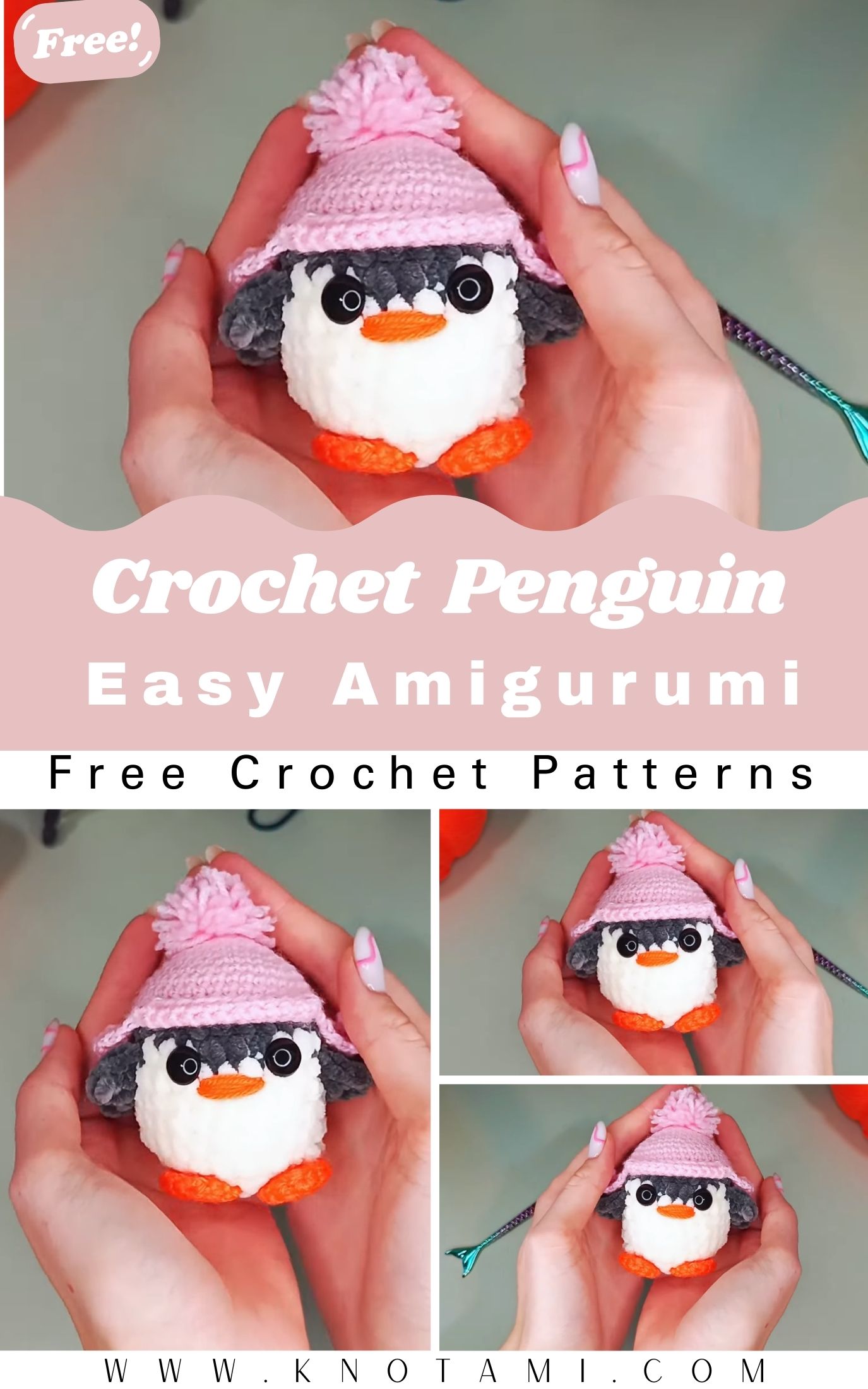
Plush charcoal chenille covers the head of a round, squishy body in this cute crochet penguin amigurumi no-sew pattern. A creamy belly, two tiny orange feet, and flippers worked right into the rounds finish the look, so you don’t have to sew on any flippers or feet.
Most plush penguins come in six or seven separate parts that need stitching together. Here, the flippers are short chain strips made inside a single round, and the feet grow straight out of free front loops at the base. A zigzag spike-stitch border gives the belly a crisp edge, and the whole penguin comes together in one afternoon.
Pattern Overview
- Worked from the top of the head down in continuous spiral rounds.
- The flippers are made inside Round 6, and the feet are worked into free front loops at the base.
- Only the beak is embroidered with a needle.
- Finished size: About 5 inches tall and 4 inches wide with bulky chenille.
- Time: About 2 to 2.5 hours, including finishing.
Materials
- Chenille yarn: Bulky weight (6), about 30 g in charcoal gray and 40 g in cream.
- Orange yarn: A few meters of smooth worsted weight (4) acrylic.
- Crochet hooks: 4.5 mm for the chenille and 3.5 mm for the orange feet.
- Eyes: A pair of 9 mm black safety eyes with locking backs.
- Stuffing: Polyester fiberfill.
- Tools: A locking stitch marker, a tapestry needle, and scissors.
Safety note: For babies and toddlers, embroider the eyes with black yarn instead of using safety eyes.
Abbreviations (US Terms)
- MR – magic ring
- ch – chain
- sl st – slip stitch
- sc – single crochet
- hdc – half double crochet
- dc – double crochet
- inc – increase (2 sc in the same stitch)
- dec – invisible decrease
- spike sc – single crochet worked into the stitch two rounds below
- BLO – back loop only
- (n) – stitch total at the end of the round
Special Techniques
- Chain-strip flippers: Partway through a round, you chain a short strip, work back down it, and keep going around the body. The strip hangs free as a flipper, so it never needs sewing on. It doesn’t count toward the round’s stitch total.
- Spike stitch border: Insert your hook into the matching stitch two rounds below, pull up a long loop to the current height, and finish it as a normal sc. In a new color, each spike drops a small point into the gray, creating the zigzag edge between head and belly.
- Counting chenille: Chenille hides the tops of the stitches. Feel for the gaps with your fingertip and rely on your stitch marker rather than your eyes.
How to Crochet the No-Sew Penguin
Step 1: Crochet the Head (Rounds 1–6, Charcoal)
With the 4.5 mm hook and charcoal chenille, place your marker in the first stitch of every round.
- Round 1: MR, 6 sc. (6)
- Round 2: Inc 6 times. (12)
- Round 3: *1 sc, inc* 6 times. (18)
- Round 4: *2 sc, inc* 6 times. (24)
- Round 5: Sc around. (24)
- Round 6 (flippers): 5 sc, [ch 6, sc in 2nd ch from hook, hdc in next 2 ch, dc in next 2 ch], 12 sc, [ch 6, sc in 2nd ch from hook, hdc in next 2 ch, dc in next 2 ch], 7 sc. (24 sc plus 2 flippers)
Flipper check: The two flippers should sit directly opposite each other, with 12 stitches on each side. Fold the head flat to compare.
Tip: After each flipper strip, work the next sc into the very next body stitch, not back into the stitch where the strip started. A skipped or doubled stitch here pulls the head crooked. Working the dc end of the strip closest to the body makes each flipper wider at the shoulder and tapered at the tip.
Step 2: Work the Belly Border (Round 7, Cream)
Change to cream on the last stitch of Round 6.
- Round 7: *2 sc, spike sc into Round 5* 8 times. (24)
Pull the first cream stitch snug so no gap forms at the color change.
Step 3: Crochet the Body (Rounds 8–12, Cream)
- Round 8: *3 sc, inc* 6 times. (30)
- Rounds 9–12: Sc around. (30)
Count now: Round 8 should total 30. Count it twice, since chenille makes it easy to miss an extra increase.
Now place the safety eyes between Rounds 5 and 6, about 4 stitches apart and centered between the flippers. Lock the backs from the inside, then stuff the head firmly.
Step 4: Shape the Flat Base (Rounds 13–17)
- Round 13: Sc in BLO around. (30)
- Round 14: *3 sc, dec* 6 times. (24)
- Round 15: *2 sc, dec* 6 times. (18)
Stuff the body firmly, pressing the fiberfill down toward the base so the penguin sits upright.
- Round 16: *1 sc, dec* 6 times. (12)
- Round 17: Dec 6 times. (6)
Fasten off. Weave the tail through the front loops of the last round, pull it closed, and hide the end inside. The back loop round leaves a ring of free front loops around the base, which is where the feet grow from.
Step 5: Crochet the No-Sew Feet (Orange)
Turn the penguin upside down and find the free front loops from Round 13, directly below the face. Switch to the 3.5 mm hook.
- Join orange with a sl st in the front loop just left of center.
- Work (hdc, dc, hdc) in the next front loop, then sl st in the next. The first foot is done.
- Sl st in the next front loop to leave a small gap.
- Work (hdc, dc, hdc) in the next front loop, then sl st in the next. The second foot is done.
- Fasten off and weave the tails into the base.
Foot check: Both feet should poke forward the same distance. Redo either shell if one looks bigger.
Step 6: Embroider the Beak and Finish
Thread orange yarn on a tapestry needle. Enter from the base and come out just below the eyes, on the color border. Work three or four short parallel stitches that narrow to a point, forming a small downward triangle. Bring the needle back out at the base and hide the tail.
Fold each flipper so it hangs down along the side of the belly, roll the body gently between your palms to even out the stuffing, and brush any loose chenille fibers away from the face.
Video Tutorial
Common Mistakes to Avoid
- Losing count in fuzzy rounds: Chenille hides the stitch tops, so move your marker every single round.
- Uneven flippers: One strip has an extra chain. Count the 6 chains before working back.
- A gap at the color change: The first cream stitch was too loose.
- A rocking base: The BLO round was skipped, so the bottom domed instead of flattening.
- Eyes placed too late: The backs can’t be locked from the outside once the penguin is closed.
Troubleshooting
- Penguin tips forward: Push a little extra fiberfill into the back of the base through the stitches, using a blunt needle.
- Flippers stick straight out: Steam them lightly from a distance and press them down against the body until they cool.
- Chenille sheds or looks patchy: Trim stray fibers and smooth the pile with a soft brush.
- Beak puckers: The stitches were pulled too tight. Remove them and redo them with gentler tension.
Beginner Tips
- Work in good light, and tilt the piece toward it when counting.
- Keep a round tally on paper, since chenille rounds all look alike.
- Crochet a little slower than usual, because chenille can “worm” if you pull it hard.
Personalization and Color Ideas
- Winter scarf: Ch 40 in red worsted yarn, work sc back along the chain, and tie it around the neck at the color border.
- Tiny hat: Make a small cone in pink or red with a pom-pom tip and tuck it over the top of the head.
- Ornament loop: Before you pull Round 1 tight, thread a yarn loop through the magic ring so the penguin can hang from a branch.
- Color swaps: Try navy and cream for a classic look, pastel pink and white for a nursery shelf, or light gray and cream for a soft, modern feel. Keep the feet and beak orange, since the bright accent is what makes it read as a penguin.
Winter Gift Packaging Ideas
- Snowy gift box: Nestle the penguin in a small box filled with white tissue paper or paper shred, like a little snowdrift.
- Mug topper: Set it inside a cozy mug with a packet of hot cocoa for a sweet winter gift.
- Gift tag friend: Add the ornament loop and tie the penguin onto a wrapped present instead of a bow.
- Holiday basket: Pair it with a mini Santa keychain or a crochet Christmas snowman for a winter bundle.
Want a smaller penguin project? Try this crochet penguin hair tie next.
Ways to Use Your Penguin
A soft chenille penguin makes a cuddly shelf buddy, a winter table decoration, or a quick handmade gift. Since the flippers and feet grow out of the body, there are no sewn parts to come loose with handling.
Care and Storage
Spot clean with a damp cloth and mild soap, then blot with clean water. Chenille mats when agitated, so skip the washing machine. Press the penguin gently in a towel, air dry it away from heat, and brush the pile lightly once dry.
Store it in a breathable cotton bag or an open basket, away from direct sun, since bright light can fade dark chenille. Avoid stacking heavy items on top, and fluff the pile every few months.
Frequently Asked Questions
Can I use regular yarn instead of chenille?
Yes. Worsted acrylic or cotton with a 3.5 mm hook works with the same round counts and gives a smoother penguin about 3.5 inches tall.
Are safety eyes suitable for babies?
No. For babies and toddlers, embroider the eyes with black yarn instead.
Is there any sewing at all?
Only the embroidered beak and hiding the yarn tails use a needle. The flippers and feet are crocheted in place.
Why is there a back loop round at the base?
It flattens the bottom so the penguin stands on its own, and it leaves the front loops you need for the feet.
Ready to Waddle Onto Your Shelf
Three small habits carry this whole project: moving the marker every round, keeping the flippers lined up across from each other, and working that back loop round at the base. Get those right, and your chenille penguin stands proudly without a single sewn-on part. One penguin rarely stays alone for long, so a navy or pastel buddy might be next on your hook.