
Soft cotton yarn curls into tiny horns and a spotted face in this mini cow amigurumi pattern where you crochet a tiny cow with the magic finger method. It’s a pocket-sized farm friend built on a snug starting loop and a little simple color work.
The magic finger start is what makes this pattern special. There’s no ring tool and no loose loops, just yarn tensioned on your fingertip for tight first stitches, which really matters at this small size. Beginners gain confidence quickly, because the whole cow uses only single crochet, increases, decreases and slip stitches, while the spots give easy color-change practice.
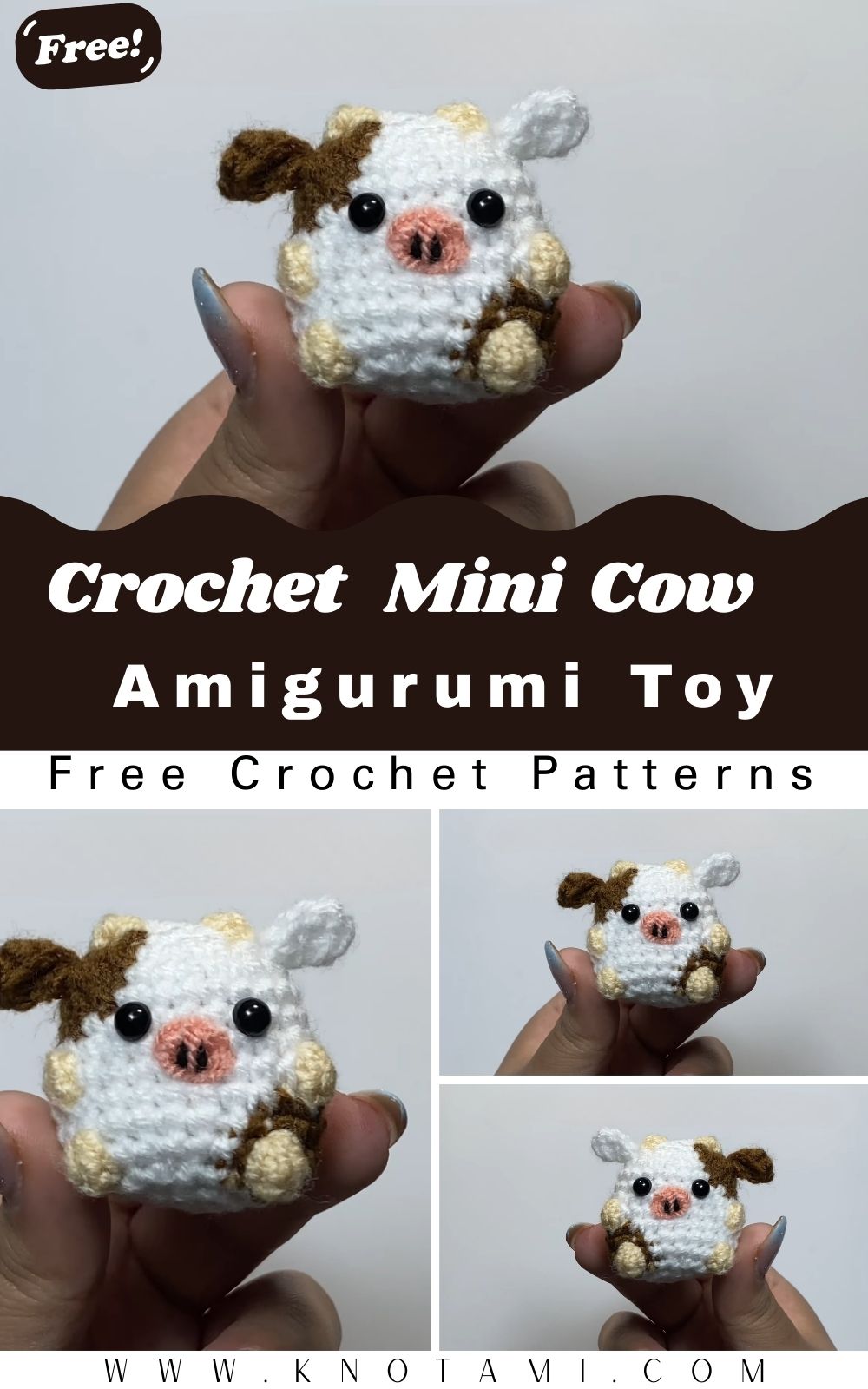
Project Overview
- Skill level: Beginner
- Pieces: Head, body, 2 ears, 4 legs, muzzle, 2 horns and a tail
- Time: About 2 to 2.5 hours. Plan roughly 10 minutes of prep, 90–120 minutes of stitching, and 20–30 minutes for stuffing, assembly and embroidery.
Materials
- Base color (white or cream): Fine cotton yarn, about 20–25 yards, for the head and body
- Spot color (black or brown): About 8–10 yards, for the spots, ears and hooves
- Pink or light tan: A small amount for the muzzle
- Gray or cream: A small amount for the horns
- Hook: 2.25 or 2.5 mm, to keep stitches tight enough to hide the stuffing at this small size
- Eyes: 4 or 5 mm safety eyes for display pieces, or black thread to embroider them
- Stuffing: Polyester fiberfill, added in small pinches
- Notions: Stitch marker, tapestry needle, scissors, and tweezers for stuffing tiny parts
Safety note: For a cow going to a baby or toddler, embroider the eyes. Safety eye backings, tiny horns and ears can work loose over time and are a choking risk for children under three.
Abbreviations
- MF – magic finger (a magic ring made on your fingertip)
- ch – chain
- sc – single crochet
- inc – increase (2 sc in the same stitch)
- dec – invisible decrease
- sl st – slip stitch
- st(s) – stitch(es)
Before You Start
The magic finger: This is a variation of the magic ring. Instead of wrapping the yarn around two fingers or a tool, you tension the loop directly on one fingertip. It gives a tighter starting circle, which suits miniature pieces where even a tiny gap shows.
Tension: Exact gauge doesn’t matter, but hold a finished round up to the light. If stuffing would show through, use a smaller hook or crochet tighter.
Markers: Place a stitch marker at the start of every round. Losing track for even one round throws off the shaping.
Colorfastness: If you’re pairing a dark spot color with a white base, dampen a scrap of both on a paper towel first. Some dark cottons bleed onto lighter colors.
Watch the Video Tutorial
The video shows the magic finger start up close, along with every part of the cow. Watch it alongside the written rounds below.
Step-by-Step Mini Cow Pattern
Step 1: Head
- Rnd 1: 6 sc in MF (6)
- Rnd 2: inc around (12)
- Rnd 3: [sc, inc] around (18)
- Rnd 4: [sc 2, inc] around (24)
- Rnds 5–8: sc around (24)
Insert the safety eyes between Rounds 7 and 8, about 6–7 stitches apart, and lock the backs.
- Rnd 9: [sc 2, dec] around (18)
- Rnd 10: [sc, dec] around (12). Stuff the head firmly now.
- Rnd 11: dec around (6)
Fasten off, weave the tail through the front loops of the last 6 stitches, and pull closed.
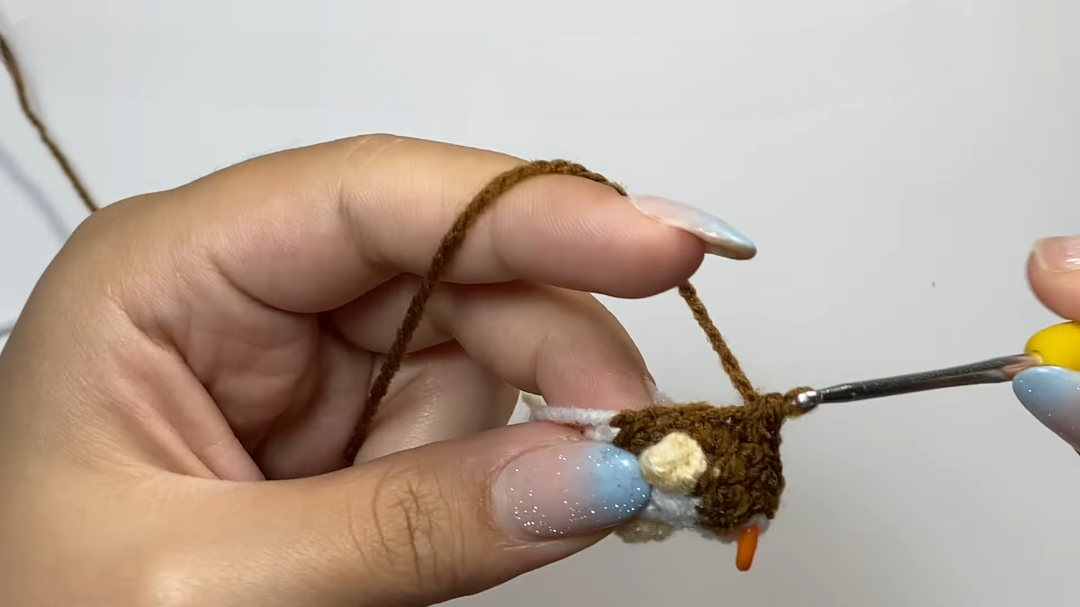
Step 2: Body
- Rnd 1: 6 sc in MF (6)
- Rnd 2: inc around (12)
- Rnd 3: [sc, inc] around (18)
- Rnds 4–7: sc around (18)
- Rnd 8: [sc, dec] around (12)
Stuff the body firmly, using tweezers to pack the fiberfill into the rounded bottom. Fasten off with a long tail for sewing to the head. Stuff the neck area well so the head doesn’t wobble later.
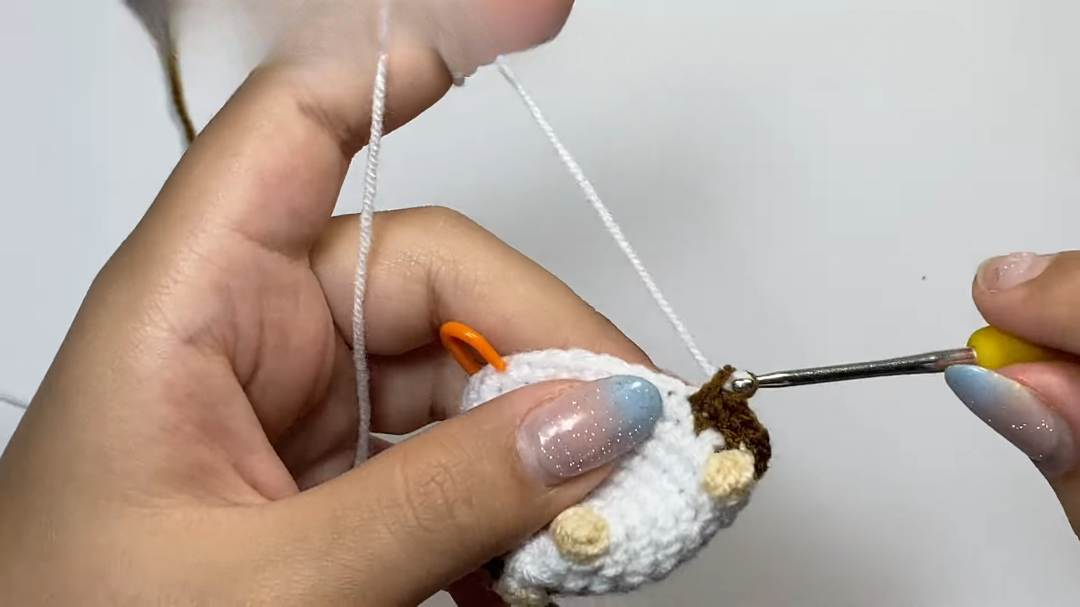
Step 3: Adding Spots
You can add spots straight into the head and body rounds by switching colors mid-round, instead of crocheting them separately. Pick up the new color on the last pull-through of the stitch before the spot, and carry the unused strand loosely along the inside instead of cutting it each time. Keep the spots random and a few stitches wide, for a natural cow look.
Step 4: Legs (make 4)
- Rnd 1: 6 sc in MF with the spot color (6)
- Rnd 2: inc around (12)
- Rnd 3: sc around (12), switching to the base color on the last pull-through
- Rnd 4: sc around (12)
Stuff lightly and fasten off with a tail for sewing. The spot-color rounds become little hooves.
Step 5: Ears (make 2)
- Rnd 1: 4 sc in MF (4)
- Rnd 2: inc around (8)
Fasten off with a tail. Fold each ear slightly and stitch the two edges together at the base, so the ear holds a gentle curve instead of lying flat.
Step 6: Muzzle
With pink or light tan, ch 5.
- Rnd 1: sc in 2nd ch from hook, sc in next 2 ch, 3 sc in last ch. Working along the other side of the chain, sc in next 2 ch, 2 sc in the last ch (10)
- Rnds 2–3: sc around (10)
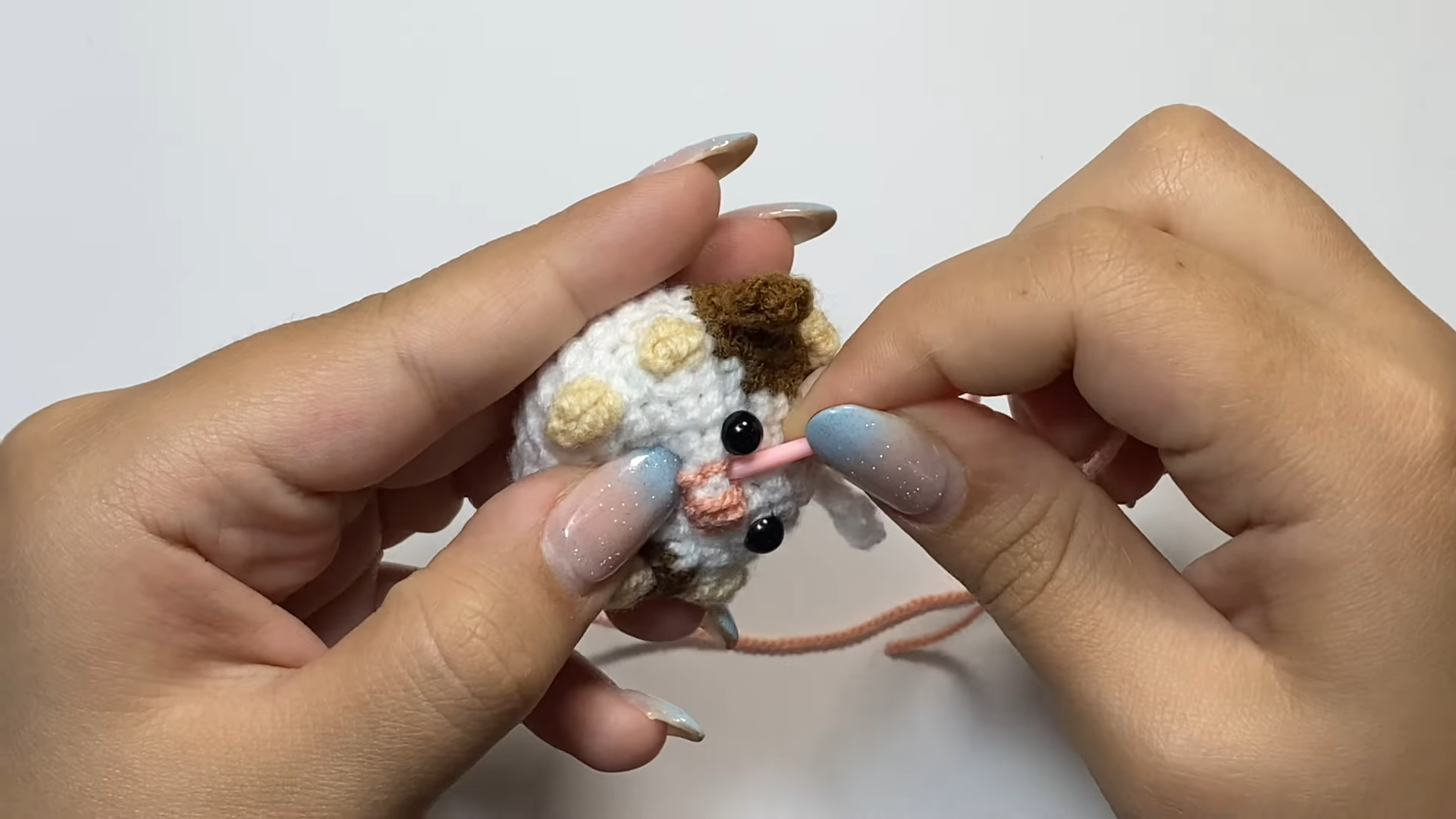
Fasten off with a tail. After sewing it on, embroider two small nostrils.
Step 7: Horns (make 2)
- Rnd 1: 4 sc in MF (4)
- Rnds 2–4: sc around (4)
Fasten off, stuff very lightly with tweezers, and curve each horn gently with your fingers before sewing.
Step 8: Tail
Ch 8, then sl st back along the chain. Knot a few short strands of the spot color at the end and fluff them into a little tuft.
Step 9: Assemble the Cow
- Lay the ears, horns and muzzle on the head and look from a few angles before sewing anything. A few seconds here saves unpicking later.
- Sew the head to the body, keeping the face centered over the front.
- Sew the muzzle on the lower half of the face, below the eyes, and embroider the nostrils.
- Attach the ears on the sides of the head just above eye level, and the horns slightly behind and above them.
- Sew the legs to the underside of the body so the cow balances in a sitting or standing pose.
- Add the tail at the back. Weave every yarn end through several stitches in different directions before trimming.
Stitch Count Checkpoints
- Head, widest rounds: 24 sts
- Body, widest rounds: 18 sts
- Legs after the increase round: 12 sts
- Muzzle: 10 sts
- Ears and horns: matching counts on both pieces
Common Mistakes
- A loose magic finger loop, which leaves a tiny hole at the center of the head or body
- Cutting and rejoining colors, which leaves more ends and visible jogs
- Legs or ears that don’t match because of uneven increase rounds
- Eyes placed too close together or too high, which gives an odd expression
Troubleshooting
- The center hole won’t close: Pull the starting tail tighter before weaving it in, or take an extra stitch across the gap with your needle.
- A twisted seam between head and body: The pieces were joined a stitch or two off. Line up the round starts before sewing.
- Stuffing peeks through: Your hook is too big for the yarn. Size down, or crochet tighter next time.
Size and Color Ideas
Using worsted weight yarn with a 3.5–4 mm hook roughly doubles the size, turning the same rounds into a huggable 5–6 inch cow. For an even tinier charm, use crochet thread with a small steel hook.
- Classic black-and-white Holstein spots
- Warm brown-and-white Jersey coloring
- Solid cream or tan for a simple farmhouse look
- Pastel spots for a nursery-friendly version
- A birthstone-colored spot shade for a keepsake gift
Make It a Keychain or Bag Charm
At this size, the mini cow is just right for carrying around. Here’s how to turn it into a charm that lasts.
- Anchor loop: With a tapestry needle, sew a small yarn loop through the top of the head between the horns, passing through several times so it’s strong.
- Hardware: Add a jump ring through the loop, then a keyring or lobster clasp. Close the jump ring fully with pliers.
- Embroidered eyes: A charm gets knocked around, so stitched eyes last longer than safety eyes.
- Bell collar: Sew a thin cord with a tiny bell around the neck seam for a farmhouse touch.
- Initial charm: Hang a small beaded initial from the tail for a personalized gift.
For more farm and animal friends, try the goat keychain amigurumi and the two-inch crochet horse, which pair perfectly with this cow. The mallard duck amigurumi and the sheep glasses holder complete the farmyard.
Care Instructions
Spot clean with a damp cloth and mild soap, then let the cow dry fully before handling, because squeezing damp amigurumi shifts the stuffing. Skip the washing machine if safety eyes are attached, since agitation loosens the backs.
FAQs
How many rounds does the head take?
Eleven in total: four increase rounds up to 24 stitches, four even rounds, then three decrease rounds to close.
What’s the difference between a magic ring and a magic finger?
A magic ring wraps yarn around one or two fingers or a ring tool. A magic finger tensions the loop on a single fingertip, which many crocheters find gives a tighter start for very small pieces.
How much yarn does the mini cow use?
Roughly 35–45 yards across all colors, so one small ball of the base color and scraps of the accents are enough.
Can I embroider the eyes instead?
Yes. Black thread eyes are the safer choice for babies and toddlers, since they can’t be pulled loose.
Tiny Hooves, Big Personality
This little cow proves you don’t need a big project to make something full of character. A tight magic finger start, a few spots and a curled pair of horns are all it takes. Make one in classic black and white, then let the herd grow in whatever colors make you smile.