

Turn heads with the Luxurious Crochet Rippletide Peplum Top Pattern, wave-kissed texture, flirty flare, cinched waist, breezy drape, size-inclusive fit. A fast, feel-fabulous make for modern wardrobes.
Make a splash with the Luxurious Crochet Rippletide Peplum Top Pattern, a modern, figure-flattering silhouette with wave-kissed texture, cinched waist, and breezy peplum flare. Designed for comfort and confidence, it includes size-inclusive instructions, simple stitches, and easy customization for length and neckline. Pair it with jeans, skirts, or shorts; work it in cotton or silky blends for year-round versatility.
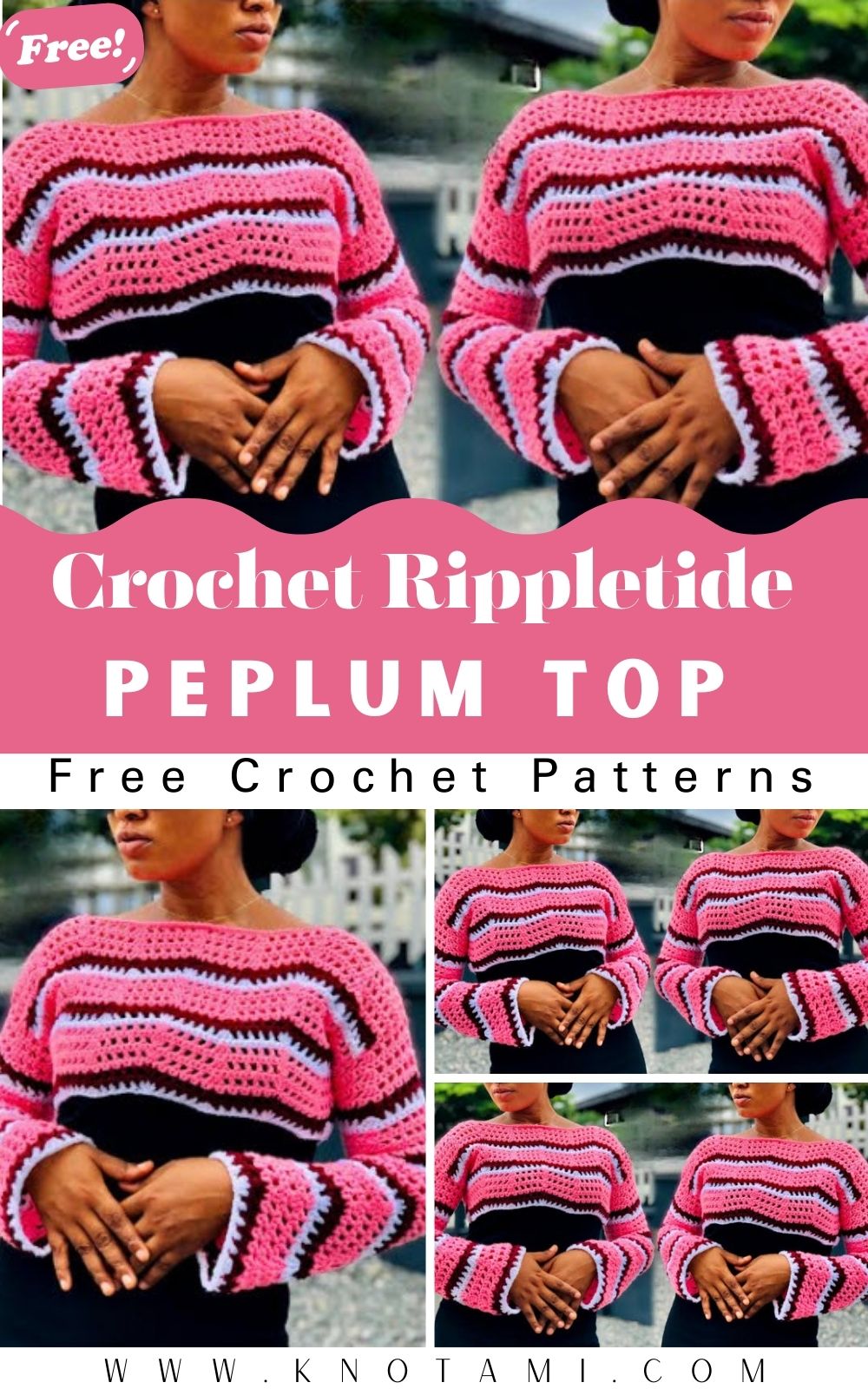
Whether you’re a confident beginner or seasoned crocheter, this quick, feel-fabulous make adds instant polish to your handmade wardrobe. The rippling fabric skims the body and sways with every step.
Uses:
- Date nights, brunches, and summer parties
- Layer under a blazer or cardigan for work-chic polish
- Gift to loved ones or stock for craft fairs
Luxurious Crochet Rippled Peplum Top Pattern
Because you love wearable makes that look polished yet feel effortless, this Luxurious Crochet Rippletide Peplum Top Pattern brings wave-kissed texture, a flattering cinched waist, and a breezy peplum into one cozy project. Moreover, the ripple stitch is rhythmic and beginner-friendly, while the silhouette is easy to adjust for your perfect fit. Consequently, you’ll move from swatch to swish in clear, confidence‑boosting steps. Finally, you’ll finish with a size‑inclusive, season‑spanning crochet peplum top you’ll be proud to wear and share.
What You’ll Make (And Why You’ll Love It)
Firstly, you’ll crochet two simple panels in a gentle ripple stitch for a modern texture that naturally skims the body. Secondly, you’ll seam shoulders and sides for a clean, polished shape. Next, you’ll add a soft neckline edging that lies flat and feels comfortable. Then, you’ll pick up stitches at the waist and work a graceful peplum that flares as much or as little as you like. Consequently, this top works beautifully with jeans, skirts, and tailored pants. Furthermore, it’s easy to style for summer in cotton or for cooler months in wool blends. Finally, beginners enjoy the straightforward repeats, while experienced makers appreciate the elegant finish.
Materials and Exact Measurements
Because materials influence fit and drape, choose yarn and hook sizes thoughtfully.
- Yarn (Worsted/Size 4; cotton, acrylic, or blends)
- XS–S (to fit 30–34 in bust): 650–800 yd (595–730 m); 320–380 g
- M–L (to fit 35–40 in bust): 800–1000 yd (730–915 m); 380–460 g
- XL–2X (to fit 41–48 in bust): 1000–1200 yd (915–1100 m); 460–550 g
- 3X–5X (to fit 49–60 in bust): 1200–1500 yd (1100–1370 m); 550–680 g
- Additionally, you can double a light-weight yarn to equal a Size 4 if you prefer color‑mixing.
- Hooks
- 4.5 mm for the body (recommended)
- 5.0–5.5 mm optionally for peplum flare and flutter sleeves
- 3.5–4.0 mm, optionally for neckline edging
- Note: Because your tension is unique, adjustthe hook size to match the gauge.
- Notions
- Measuring tape, scissors, stitch markers (6–10), yarn needle, and clips
- Steam iron or blocking mats and pins (for finishing)
- Gauge (in Ripple Pattern, after light blocking)
- 22 chains (one repeat) ≈ 5 in (12.7 cm) wide
- 4 rows (Ripple + SC + Ripple + SC) ≈ 2 in (5 cm) high
- Consequently, always swatch before starting to ensure accurate sizing.
- Finished Measurements (customizable)
- Bodice length to waist: 14–17 in (36–43 cm), depending on torso length
- Peplum depth: 6–10 in (15–25 cm), depending on preference
- Total length: 20–27 in (51–69 cm), depending on your choices
- Recommended ease at bust: 1–3 in (2.5–7.5 cm) positive ease for soft drape
Sizing Strategy (Read Before You Start)
Because thoughtful planning prevents fit issues, take quick measurements first.
- Measure bust at the fullest point; then divide by 2 for one panel’s target width.
- Add ease (1–3 in / 2.5–7.5 cm) to that half-bust for a comfortable fit.
- Make a ripple swatch to learn your personal multiple widths.
- Choose the number of repeats so thatthe panel width ≈ is half-bust + ease.
- Therefore, foundation chains per panel = (22 × number of repeats) + 3.
Example:
- If your half-bust + ease equals 20 in and one multiple equals 5 in for you, you’ll use 4 repeats (4 × 5 = 20 in). Consequently, your starting chain is (22 × 4) + 3 = 91.
Additionally, if you are between sizes, choose the larger panel width and, subsequently, start the peplum 1 in higher to visually “cinch” the waist.
Abbreviations (US Terms)
Because clarity matters for beginners, here are the simple stitches you’ll use:
- ch = chain
- sc = single crochet
- dc = double crochet
- dc3tog = double crochet 3 together (across 3 consecutive stitches)
- st(s) = stitch(es)
- sp = space
- rep = repeat
Ripple Stitch Anatomy (What You’ll Repeat)
Because rhythm helps you stitch faster, remember this sequence:
- Rise: dc, ch 1, skip 1, dc, ch 1, skip 1, dc, ch 1, skip 1, dc (four “columns” of dc separated by ch-1)
- Peak: 3 dc in the same stitch
- Rise again: four DC columns with ch‑1 spaces between
- Valley: dc3tog across the next 3 sts
Consequently, you’ll alternate ripple rows with stabilizing sc rows for a neat, wearable fabric.
Construction Overview
- Firstly, crochet front and back panels from the hem to the shoulders.
- Secondly, seam the shoulders and sides to form armholes.
- Next, add a soft neckline edging that lies flat.
- Then, pick up stitches at the waist and work the peplum downward.
- Finally, weave in ends and block for professional polish.
- Optionally, add short flutter sleeves using the same ripple rhythm.
Step‑by‑Step Instructions with Times
Note: Because speed and size vary, times reflect a relaxed pace for size M.
- Swatch and Fit Planning (30–45 minutes)
- Foundation: Ch 44 + 3.
- Row 1 (Ripple): Dc in 4th ch from hook. Then [ch 1, skip 1, dc in next] three more times (4 dc columns total). Next, ch 1, skip 1, work 3 dc in next ch (peak). Then [ch 1, skip 1, dc in next] four times. Next, ch 1, skip 1, dc3tog across next 3 sts (valley). Repeat rise–peak–rise–valley across. Finally, when 3 sts remain, ch 1, skip 1, dc2tog over last 2 sts for a tidy edge.
- Row 2 (Stability): Ch 1, turn, sc across, placing sc in every dc and ch‑1 sp.
- Rows 3–4: Repeat Rows 1–2.
- Measure: Determine your width per 22‑ch multiple and row height. Consequently, calculate panel width and starting chains as described in Sizing Strategy.
- Front Panel (2.5–3.5 hours)
- Foundation: Ch (22 × chosen repeats) + 3.
- Row A (Ripple): Work the rise–peak–rise–valley sequence exactly as in your swatch, ending cleanly with dc2tog over the last 2 sts.
- Row B (SC): Ch 1, turn, sc across into each dc and each ch‑1 sp for a smooth, wearable fabric.
- Continue: Repeat Rows A–B until the panel measures your desired bodice length to the waist (usually 14–17 in). Because you will add the peplum later, stop at the waistline.
- Optional front neckline shaping (last 1–2 in): Because a gentle scoop is flattering, mark the center 6–10 in. Then, work each shoulder separately, decreasing one “dc column” toward the center every other ripple row for 2–4 rows. Meanwhile, keep your shoulders straight so seaming remains simple.
- Back Panel (2–3 hours)
- Because symmetry simplifies construction, repeat the front panel with the same number of rows.
- Optionally, keep the back neckline higher by skipping shaping. Consequently, the top will sit comfortably and reduce front gaping.
- Join Shoulders (15–25 minutes)
- With right sides facing, align front and back. Then seam the shoulders using a mattress stitch for a flat, flexible join. Alternatively, sc seam with a relaxed hand.
- Leave a neck opening of 7–10 in (18–25 cm), depending on your preference. Because you’ll add edging, this opening will finish neatly.
- Side Seams and Armholes (20–30 minutes)
- From the shoulder seam, measure down 7–9.5 in (18–24 cm) for your armhole depth; then place markers on both sides.
- Seam from the hem up to each underarm marker using mattress stitch. Because tight seams can pucker, keep tension even and gentle.
- Try on; then adjust seam placement if needed before weaving in ends.
- Neckline Edging (15–20 minutes)
- With the right side facing, join the yarn at one shoulder seam. Then work a light, flexible finish.
- Round 1: Ch 3 (counts as dc), [ch 1, skip a small gap if needed, dc evenly around] ensuring the edge lies flat. Furthermore, ease slightly around curves to prevent rippling.
- Round 2: Ch 1, sc around, placing sc into each dc and ch‑1 sp; sl st to join; fasten off.
- Consequently, you’ll get a neat, comfortable neckline that complements the ripple texture.
- Prepare the Waistline for Peplum (15–20 minutes)
- Try on and mark your natural waist or preferred high‑hip point. Because placement shapes the silhouette, choose the spot that visually flatters you.
- With the right side facing, join yarn at a side seam along the waist edge.
- Foundation Round: Work one round of sc evenly around the waist. Then, lightly steam or pat into place so it sits flat.
- Stitch count target: Because the ripple works best in repeats, aim for a count that fits (22 × repeats) + 1 around. Consequently, add or subtract a few sc to hit that target without puckers.
- Peplum in the Round (2–3 hours)
- Round 1 (Set Ripple): Ch 3, then establish four dc columns with ch‑1 spaces; next, work 3 dc in the same st for the peak; then create four dc columns again; finally, work dc3tog for the valley. Consequently, repeat this rise–peak–rise–valley pattern around; then join with a sl st.
- Round 2 (SC): Ch 1, sc around (into each dc and ch‑1 sp) to stabilize the flair.
- Build length: Repeat Round 1 and Round 2 alternately until the peplum measures 6–10 in (15–25 cm), depending on your preferred drama.
- Increase flare smoothly:
- Option 1 (Hook change): After 2–3 ripple pairs, switch from 4.5 mm to 5.0 or 5.5 mm to encourage graceful drape without extra counting.
- Option 2 (Peak boost): Every other ripple row, work 4 dc (instead of 3 dc) into each peak for a gradual flare.
- Finish edge: End with one final sc round for structure; then fasten off.
- Because fabric memory varies by fiber, consider a quick steam block to relax the waves and let the peplum hang evenly.
- Optional Flutter Sleeves (1–2 hours each; 20–30 minutes for a minimal cap)
- If you prefer a sleeveless look, you can skip sleeves entirely. However, if you want extra movement, proceed.
- Round 1 (Pick up): With the right side facing the underarm seam, join yarn. Then work sc evenly around the armhole. Because counts vary, aim for (22 × repeats) + 1 to maintain the ripple rhythm.
- Round 2 (Ripple): Ch 3, set four dc columns with ch‑1 spaces; next, 3 dc in the same st for peaks; then, four dc columns; finally, dc3tog for valleys; join.
- Round 3 (SC): Ch 1, sc around; join.
- Flare: After 2–3 repeat pairs, optionally switch to a larger hook or add 4 dc at peaks every other ripple row for a fluttery edge.
- Finish: End with one sc round; fasten off and weave in ends.
- Finishing and Blocking (30–45 minutes)
- Weave in all tails securely, especially at color changes if you used stripes. Additionally, trim yarn neatly on the wrong side.
- Because blocking elevates texture, gently steam or wet‑block according to your fiber. Then shape ripples, smooth seams, and let the peplum hang evenly.
- Finally, try on and admire the movement; then note any small tweaks for your next make (for example, slightly higher waist or deeper peplum).
Basic Tips for Beginners
- Swatch with purpose: Because your tension controls fit, always measure the width of one 22‑chain multiple before committing. Consequently, you’ll choose the right number of repeats.
- Count the rhythm: Moreover, keep markers at peaks (3 dc) and valleys (dc3tog) for the first few rows; then the pattern becomes almost meditative.
- Ease at seams: Because tight seams cause puckers, either seam with a larger hook or keep your hand relaxed.
- Try on often: Additionally, pause after shoulder and side seams, and again midway through the peplum, to confirm drape and length.
- Match fiber to season: For summer, choose cotton or bamboo for crisp stitch definition; for fall, consider acrylic or wool blends for cozy bounce.
Common Mistakes (And How to Avoid Them)
- Incorrect foundation multiple: If you ignore (22 × repeats) + 3 for panels or (22 × repeats) + 1 for in‑the‑round, your ripples won’t stack. Therefore, recalculate your start count carefully.
- Forgetting ch‑1 spaces: Because the wave relies on spacing, missing ch‑1 gaps flattens the ripple. Consequently, count your “four columns” deliberately.
- Overpacked neckline: If you place too many stitches around curves, the edge will ruffle. Thus, pick up evenly and adjust by one or two stitches as needed.
- Over‑flared peplum: If you jump to a much larger hook too soon or increase at every peak, you may get ripples, not drape. Therefore, increase gradually and assess after each pair of rows.
- Tight side seams: Because stiff seams fight the fabric, seam with light tension or switch to mattress stitch for flexibility.
Variations You’ll Love
- Color‑blocked waves: Additionally, try a three‑color scheme, light at the top, mid‑tone at the waist, and dark at the peplum for a chic ombré effect. Consequently, carry unused yarn neatly up the seam to minimize ends.
- Cropped and flirty: Alternatively, shorten the bodice by 2 in and add a 6‑in peplum for a high‑waist pairing.
- Sleek and minimal: If you prefer less volume, keep a single hook size for the peplum and skip peak increases for a soft A‑line.
- Bold and dramatic: Conversely, extend the peplum to 10–12 in and add 4 dc at peaks every other ripple row for runway‑ready movement.
- Neckline tweaks: Furthermore, soften to a scoop at the front by shaping the last 1–2 in, or keep a classic, high crew by skipping shaping entirely.
Sizing Tips at a Glance
- Choose repeats based on your swatch; then aim for half‑bust + 1–3 in ease per panel.
- Keep front and back on the same repeat count for balanced seams.
- Start peplum at your natural waist if you want a defined silhouette; alternatively, start at high hip for relaxed ease.
- If you’re between sizes, size the bodice up slightly; then, consequently, begin the peplum 1 in higher for a tailored look.
SEO‑Friendly Summary (Blended Naturally)
Because this pattern emphasizes fit, flow, and simplicity, the Luxurious Crochet Rippletide Peplum Top Pattern offers beginners a confident path to a beautifully textured, size‑inclusive top. Moreover, with clear ripple repeats, stabilizing sc rows, and a customizable peplum, you’ll enjoy both process and polish.
Estimated Total Making Time by Size for (Crochet Rippletide Peplum Top Pattern)
- XS–S: 6–8 hours
- M–L: 7–9 hours
- XL–2X: 8–10 hours
- 3X–5X: 9–12 hours
Because your speed, fiber, and flare choices vary, these estimates serve as a friendly guide rather than a rule.
Care and Wear
- Wash: Because fibers differ, follow yarn labels; however, most cottons prefer cool hand wash, while many acrylics are machine‑washable.
- Dry: Lay flat to dry; then shape ripples and peplum.
- Store: Additionally, fold flat or hang on a padded hanger to preserve the peplum’s drape.
Final Encouragement for (Crochet Rippletide Peplum Top Pattern)
Ultimately, this Luxurious Crochet Rippletide Peplum Top Pattern turns simple stitches into a standout piece. Because the ripple rhythm is soothing and the steps are beginner-friendly, you’ll move smoothly from planning to finishing. Furthermore, the peplum’s graceful swing adds instant style to everyday outfits. Consequently, whether you keep it sleek and minimal or dial up the drama with more flair, you’ll enjoy a handmade top that feels luxe, fits beautifully, and reads effortlessly chic on you and on the page.