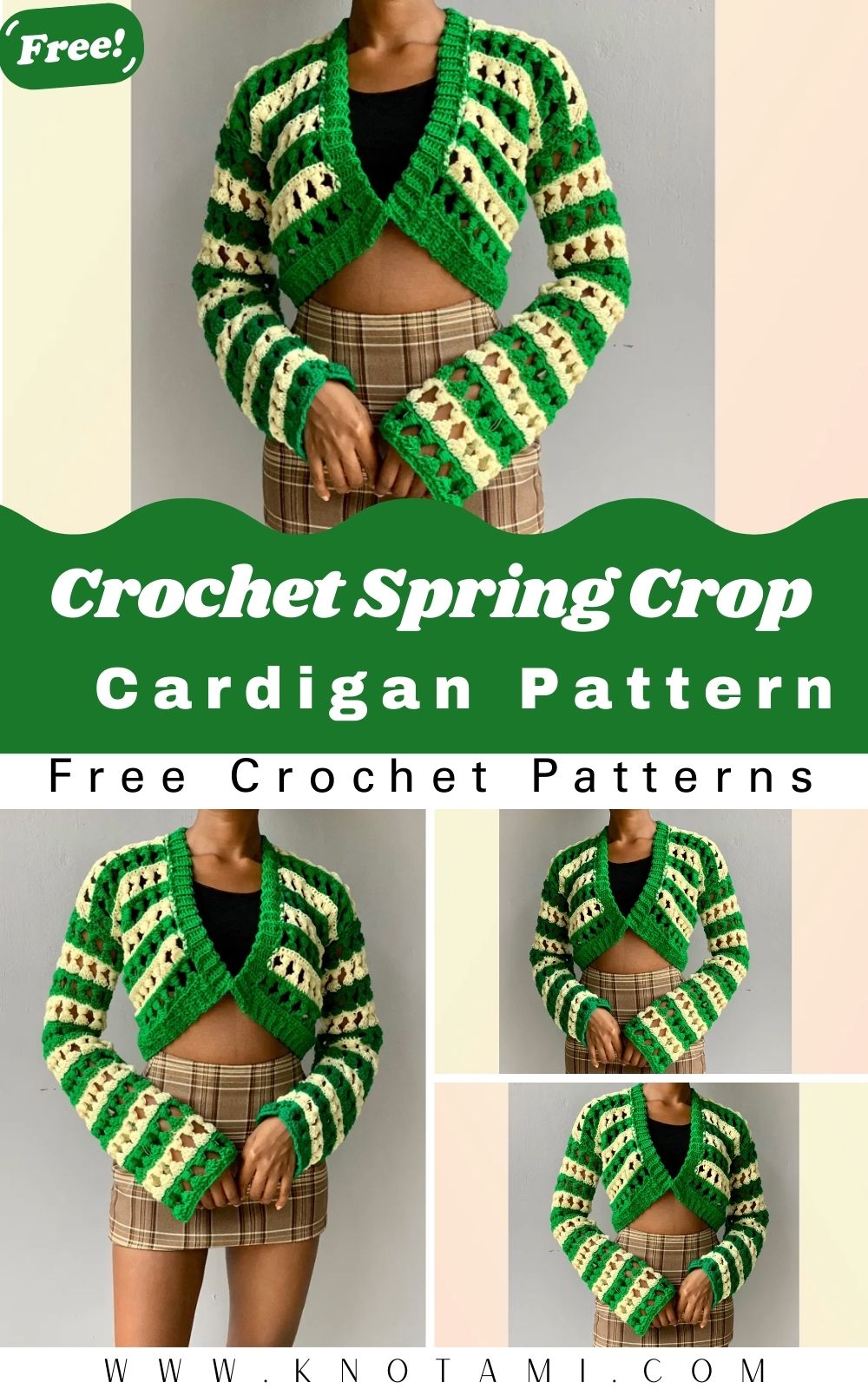
Luxurious Crochet Spring Crop Cardigan Pattern

Level up your spring wardrobe with this Luxurious Crochet Spring Crop Cardigan pattern featuring soft drape, quick stitches, and adjustable length for effortless, everyday elegance.

The Luxurious Crochet Spring Crop Cardigan Pattern delivers a light, breezy layer for warm days and cool nights using easy stitches and clear, step-by-step instructions, so beginners can follow with confidence.

Luxurious Crochet Spring Crop Cardigan Pattern

You can customize the length and sleeves to suit your style, and it works beautifully with soft cotton or DK yarn for a comfy fit. It is quick to make, polished to wear, and perfect for everyday outfits. Pair it with a dress, a tee, or high-waisted jeans for simple spring style.

Uses:

  • Brunch and daytime outings
  • Vacation or festival layering
  • Light office cover-up

Luxurious Crochet Spring Crop Cardigan Pattern
Wrap yourself in lightness with this beginner-friendly spring crop cardigan that looks polished yet feels effortless. Because the construction relies on clean rectangles and simple seams, you can relax and enjoy the make from the very first stitch. Moreover, the steps include clear sizing tips, exact measurements, and approachable techniques, so confident beginners can follow along with ease. While the video linked above shows a bead stitch approach for sleeves and assembly, this written pattern offers a simpler core fabric for accessibility, plus an optional sleeve variation inspired by that tutorial. Consequently, you get a beautiful, breathable layer that pairs with dresses, tees, or high-waisted jeans for instant spring style.

Skill Level

  • Beginner-friendly for the main pattern.
  • Advanced beginner for the optional bead stitch sleeve variation inspired by the video.

Construction Overview

  • Drop shoulder cardigan built from three rectangles for the body: one back panel and two front panels.
  • Shoulders and sides seamed, leaving armholes.
  • Sleeves worked in the round from the armhole, or worked flat and seamed.
  • Button band and neckline added last using easy ribbing.
  • Cropped length with optional adjustments.

Fit and Ease

  • Intended ease: 2 to 4 inches for a relaxed, wearable fit.
  • Choose your size by your full bust measurement, then compare it to the finished bust for the look you prefer.
  • For layering, consider the larger of the two sizes if you are between measurements.

Materials and Exact Measurements

  • Yarn: DK weight category 3. Cotton or a cotton blend is recommended for spring comfort and drape.
    • Yardage by size (approximate):
      • XS 500 yds
      • S 550 yds
      • M 650 yds
      • L 750 yds
      • XL 850 yds
      • 2X 950 yds
      • 3X 1050 yds
      • 4X 1150 yds
      • 5X 1250 yds
  • Hooks: 4.0 mm for the main fabric, 3.5 mm for ribbing and button band.
  • Notions:
    • 4 to 6 buttons, 0.75 to 1 inch diameter
    • 5 to 8 stitch markers
    • Tapestry needle
    • Measuring tape
    • Sharp scissors
    • Blocking tools
    • Scrap yarn for lifelines
  • Optional reference measurements from the video sleeves approach: starting chain 50, sleeve width about 13 inches, sleeve length about 22 inches; however, the main pattern below provides a simpler sleeve option.

Abbreviations

  • ch: chain
  • sc: single crochet
  • hdc: half double crochet
  • sl st: slip stitch
  • blo: back loop only
  • rep: repeat
  • RS: right side
  • WS: wrong side
  • st: stitch
  • sts: stitches

Gauge

  • 16 hdc and 12 rows equal 4 inches after light blocking with 4.0 mm hook
  • Therefore, 1 inch equals 4 hdc and 3 rows
  • Because cotton relaxes, measure gauge after washing and laying flat to dry

Finished Bust Measurements

  • XS 34 in, S 38 in, M 42 in, L 46 in, XL 50 in, 2X 54 in, 3X 58 in, 4X 62 in, 5X 66 in

Panel Widths for a Consistent Fit

  • Back panel width: XS 18 in, S 20 in, M 22 in, L 24 in, XL 26 in, 2X 28 in, 3X 30 in, 4X 32 in, 5X 34 in
  • Each front panel width: XS 8 in, S 9 in, M 10 in, L 11 in, XL 12 in, 2X 13 in, 3X 14 in, 4X 15 in, 5X 16 in
  • Back width plus both fronts equals the finished bust

Body Length Targets

  • Cropped length from shoulder to hem: 15 in for XS to M, 15.5 in for L, 16 in for XL to 2X, 16.5 in for 3X to 4X, 17 in for 5X
  • Adjust easily by adding or removing rows

Armhole Depth to Leave Unseamed

  • XS 7.5 in, S 8 in, M 8.5 in, L 9 in, XL 9.25 in, 2X 9.5 in, 3X 9.75 in, 4X 10 in, 5X 10.25 in

Sleeve Circumference Targets at Upper Arm

  • XS 11 in, S 12 in, M 13 in, L 14 in, XL 15 in, 2X 16 in, 3X 17 in, 4X 18 in, 5X 19 in
  • Three-quarter length: 12 to 14 in from the armhole
  • Full length: 18 to 20 in from the armhole

Read This Before You Start

  • Swatch in hdc, then wash and dry flat before measuring. Because fabric grows, the post block gauge tells the truth.
  • If your swatch is too tight, move up a hook size. Conversely, if it is too loose, move down.
  • Highlight your size in the instructions so you can follow without strain.
  • Refer to the YouTube URL for a bead stitch visual if you choose the optional variation, yet rely on the written steps here for the simpler build.

Core Fabric and Edges

  • Body fabric: hdc throughout for a smooth texture and easy speed.
  • Ribbing: sc blo for stretchy cuffs, hem, and button band.

Estimated Making Time by Section

  • Back panel: 2.5 to 4.5 hours, depending on size
  • Two front panels: 2 to 3.5 hours total
  • Join shoulders: 20 to 35 minutes
  • Neckline and button band: 1 to 1.5 hours
  • Side seams and armhole openings: 20 to 30 minutes
  • Sleeves: 2 to 4 hours each, depending on length
  • Bottom hem ribbing: 45 to 75 minutes
  • Buttons and final finish: 20 to 30 minutes, plus drying time for blocking

Sizing Math You Can Trust

  • With 4 stitches per inch, starting stitch counts for panel widths become predictable.
  • Back starting stitches: 72, 80, 88, 96, 104, 112, 120, 128, 136 for XS to 5X, respectively.
  • Front starting stitches: 32, 36, 40, 44, 48, 52, 56, 60, 64 for XS to 5, X respectively.
  • A chain gives you one fewer hdc per row than the chain count, due to the turning chain.

Step-by-Step Instructions

1. Body: Back Panel
Making time: about 2.5 to 4.5 hours

Start with a foundation chain that gives your target width. For the back, ch 73 (81, 89, 97, 105, 113, 121, 129, 137). Consequently, your first hdc row will hold 72 (80, 88, 96, 104, 112, 120, 128, 136) stitches.

  • Row 1: Hdc in the second ch from the hook and in each chain across, then turn.
  • Row 2: Ch 1, hdc in each stitch across, then turn.
  • Repeat Row 2 until the back panel measures your target body length from hem to shoulder. For example, aim for 15 inches for XS to M, then follow the size chart for larger sizes.
  • Row totals by common targets: 45 rows for 15 in, 47 rows for 15.5 in, 48 rows for 16 in, 50 rows for 16.5 in, 51 rows for 17 in.
  • Sizing check: After 10 to 12 rows, measure the height; if you are off, adjust your hook size now, not later.
  • Fasten off and leave a tail for seaming.

2. Body: Front Panels
Making time: about 2 to 3.5 hours total

Make two identical fronts. For each front, ch 33 (37, 41, 45, 49, 53, 57, 61, 65). Consequently, you will work 32 (36, 40, 44, 48, 52, 56, 60, 64) hdc per row.

  • Row 1: Hdc in the second ch from the hook and across, then turn.
  • Row 2: Ch 1, hdc in each stitch across, then turn.
  • Repeat Row 2 until each front equals the back length exactly.
  • Orientation tip: The inner long edge stays straight and becomes the opening; the outer long edge will seam to the back at the shoulder and side.

3. Join Shoulders
Making time: about 20 to 35 minutes.

Lay the back panel RS up on a flat surface. Next, position both front panels RS down on top of the back so the shoulder edges align.

  • Seam inward from each shoulder edge for about 3 to 4 inches, which creates a comfortable neck opening.
  • Use whip stitch with a tapestry needle or sl st through both layers with your 4.0 mm hook.
  • Tryit on quickly. If the neck pulls, reduce the depth of the shoulder seams slightly; if it feels too open, add a few stitches to the seam.

4. Neckline and Front Button Band
Making time: about 1 to 1.5 hours.

Switch to a 3.5 mm hook. With RS facing, attach yarn at the bottom of the right front edge.

  • Band Round 1: Work sc evenly up the right front edge, placing one sc per row end. At the back neck corner, add two sc to avoid tightness. Continue down the left front edge with one sc per row end, then turn.
  • Band Row 2: Ch 1, work sc blo across, then turn.
  • Band Rows 3 to 8: Ch 1, sc blo across, then turn each time. Eight rows produce a clean, medium-width band. If you want a bolder look, add extra rows now for a wider band.
  • Buttonholes: On the right band only, mark 4 to 6 positions evenly spaced from neck to hem. When you reach a marker on an RS row, ch 2, sk 2 sts, then continue sc blo to the next marker. On the following row, place 2 sc in each ch 2 space to complete the buttonholes.
  • Proportion tip: Larger sizes often look balanced with a 10-row band, so add rows if desired.

5. Side Seams and Armhole Openings
Making time: about 20 to 30 minutes

With the RS facing, align the front panels to the back along each side.

  • Seam from the hem upward using whip stitch or a slip stitch seam.
  • Stop when the shoulder seam to armhole depth matches your size target, for instance, 8.5 inches for M or 10 inches for 4X.
  • Secure tails and leave the upper opening for your sleeves.

6. Sleeves, Option A: Simple HDC Sleeves in the Round
Making time: about 2 to 4 hours per sleeve

This beginner-friendly sleeve option works straight from the armhole for a smooth finish.

  • With a 4.0 mm hook, attach yarn at the underarm. Ch 1.
  • Pickup Round: Work one hdc evenly around the armhole. Consequently, target these stitch counts for upper arm circumference: XS 44, S 48, M 52, L 56, XL 60, 2X 64, 3X 68, 4X 72, 5X 76. Join with sl st to the first hdc.
  • Round 2: Ch 1, hdc in each stitch around, join with sl st.
  • Continue in hdc rounds until the sleeve measures your desired length, for example, 12 to 14 inches for three-quarters or 18 to 20 inches for full length.
  • Gentle tapering: Decrease 2 stitches every sixth round at the underarm, repeating until you remove 6 to 10 stitches total, depending on size. Use hdc2tog to decrease cleanly.
  • Cuff ribbing: Switch to a 3.5 mm hook. Ch 1, then sc evenly around the sleeve opening, matching the stitch count of your last hdc round, and join. Next, ch 7 for a slim cuff. Sc in the second ch from the hook and in each chain back to the edge. Sl st in the next 2 sc of the sleeve edge, turn, skip those sl sts, then sc blo back up to the cuff top, ch 1, turn, and sc blo back down. Continue around, then join the rib ends neatly with slip stitches.

6B. Sleeves, Option B: Bead Stitch Sleeves Inspired by the Video
Making time: about 3 to 4.5 hours per sleeve

Although the body remains in simple hdc, you may prefer the video’s textured sleeve look. The referenced tutorial shows bead stitch instruction in a separate video; advanced beginners can incorporate it here.

  • Sleeve rectangle approach: Ch 50 for width. Work bead stitch rows to reach about 22 inches in length, maintaining about 13 inches of sleeve width. Because your tension may differ, measure your arm and adjust.
  • Make a second sleeve rectangle identical to the first.
  • Fold each rectangle lengthwise and seam the long edge to create a tube.
  • Set in the sleeves: With the cardigan WS up, insert each sleeve tube into the armhole so that the sleeve seam aligns with the cardigan side seam. Stitch all around the armhole to attach.
  • Finish with the cuff ribbing method described above, or leave the bead edge plain if you like the texture.

7. Bottom Hem Ribbing
Making time: about 45 to 75 minutes.

Switch to the 3.5 mm hook. Attach yarn at the bottom edge of the cardigan withthe  RS facing.

  • Foundation pass: Sc evenly around the entire hem, working across both fronts and the back, and join with sl st at a side seam.
  • Ribbing setup: Ch 9 for a slightly wider hem. Sc in the second ch from hook and in each chain back to the hem. Sl st in the next 2 sc along the hem edge, then turn.
  • Rib Row A: Skip the 2 slip stitches, sc blo in each stitch up the rib, ch 1, then turn.
  • Rib Row B: Sc blo back down to the hem, sl st in the next 2 sc, then turn.
  • Repeat Rows A and B completely around the hem. Finally, join the rib ends with slip stitches for a clean seam.

8. Buttons and Finishing
Making time: 20 to 30 minutes, plus blocking time

Align the left front band beneath the right, matching buttonholes to button positions.

  • Mark button locations with removable markers, then sew buttons securely using sturdy thread or matching yarn.
  • Weave in all ends neatly on the WS.
  • Block lightly by washing and laying the cardigan flat to dry. Because cotton can grow, shape gently to your exact measurements, then let it dry fully.
  • Try on and admire your new cardigan.

Neckline Notes and Adjustments

  • If you prefer a deeper V, seam fewer shoulder stitches in Step 3. Conversely, if you want a closer neck, seam more stitches.
  • For extra polish, add 2 to 4 more band rows across the fronts and neckline, keeping sc blo for the same ribbed look.
  • Because the band adds structure, it often improves the drape at the shoulders and helps the fronts hang evenly.

Beginner Friendly Sizing Tips (Crochet Spring Crop Cardigan Pattern)

  • Between bust sizes: choose the larger size for easy layering, especially over long sleeves.
  • Petite torso: remove 2 to 3 rows from the body, then reassess the length while trying on.
  • Fuller biceps: pick up 4 to 8 extra sleeve stitches, then decrease less frequently so the cuff still fits comfortably.
  • Broader shoulders: shorten shoulder seam depth by about half an inch per side and add 2 band rows to keep the neckline balanced.
  • Longer body: add rows in the back and fronts before working the hem ribbing; maintain the same number of rows on each panel so seams remain aligned.

Basic Tips for Success (Crochet Spring Crop Cardigan Pattern)

  • Swatch, wash, and measure before committing to your starting chains; an accurate gauge prevents surprises.
  • Mark sizes and stitch counts for your size at the outset; color highlighters reduce errors.
  • Measure every 10 rows, since early corrections take minutes instead of hours.
  • Keep edges tidy by always chaining 1 to turn, then placing the first hdc in the very first stitch.
  • Place markers for buttonholes before you crochet them, because planning keeps spacing even.
  • Use lifelines in critical rows, particularly near the hem and neckband, so ripping back never risks unraveled edges.
  • Relax your hands and shoulders; smooth tension creates a beautiful drape and a more luxurious finish.

Common Mistakes and How to Avoid Them

  • Skipping the swatch leads to bust and sleeve widths that do not match the chart; test first, then start.
  • Picking up too many stitches on the band causes rippling; too few causes puckering. Place one sc per row end and add two sc in the neck corners.
  • Twisting the sleeve pickup round creates a permanent twist; check once more before joining.
  • Working ribbing too tightly makes cuffs and hem draw in; switch to the 3.5 mm hook and keep a relaxed tension.
  • Misaligned buttonholes happen when spacing is eyeballed; instead, measure the opening and mark each position evenly.
  • Uneven lengths between fronts result from row miscounts; confirm row totals for both fronts as you go.

Fun Variations You Will Love (Crochet Spring Crop Cardigan Pattern)

  • Openwork stripe: every sixth body row, substitute a simple [dc, ch 1, sk 1] repeat, then return to hdc on the next row.
  • Color blocking: work the fronts in a contrast color and keep the back neutral; alternatively, stripe the band by alternating two shades every row.
  • Tie front: skip buttons and add two chain ties at the bust for a playful, breezy finish.
  • Longer hem: extend the ribbing chain to 11 or 13 stitches for a bold statement edge, then continue the same attachment method.
  • Textured swap: replace hdc body fabric with moss stitch while maintaining gauge, and keep the same measurements.
  • Sleeve personality: choose Option B bead stitch sleeves for texture that echoes the linked video inspiration.

Why This Pattern Works for Beginners (Crochet Spring Crop Cardigan Pattern)

  • Rectangles for the body simplify measuring and seaming, so shaping stays minimal.
  • Repetitive stitches build speed and confidence, while ribbing in sc blo is intuitive.
  • Drop shoulders create a forgiving silhouette, and sizing feels comfortable and flexible.
  • Clear checkpoints for measurement keep your project on track without guesswork.

Quick Reference Stitch Counts (Crochet Spring Crop Cardigan Pattern)

  • Back panel width stitches by size: XS 72, S 80, M 88, L 96, XL 104, 2X 112, 3X 120, 4X 128, 5X 136
  • Front panel width stitches by size: XS 32, S 36, M 40, L 44, XL 48, 2X 52, 3X 56, 4X 60, 5X 64
  • Sleeve pickup stitches at upper arm: XS 44, S 48, M 52, L 56, XL 60, 2X 64, 3X 68, 4X 72, 5X 76
  • Neckband rows: 8 standard, although 10 works beautifully for larger sizes

Notes Connecting to the YouTube Tutorial

  • The linked video demonstrates assembly concepts, sleeve construction, and ribbing attachment, which align with this pattern’s approach.
  • Back panel chains in multiples of four plus two appear in the video’s method for that stitch pattern; this written pattern standardizes counts for hdc, so follow the size chart here.
  • If you elect the bead stitch sleeve variation, consult the video for the visual explanation, then integrate the measurements and finishing steps provided above.

Short, Warm Wrap Up For (Crochet Spring Crop Cardigan Pattern)

You now have a spring cardigan that feels luxurious and looks intentionally polished, yet it remains approachable for a first garment. Because the body uses simple rectangles and the sleeves offer two clear paths, you can tailor the make to your comfort level and your timeline. Furthermore, the ribbed band and hem add just the right structure, while cotton yarn brings breathable ease. Finally, pick a favorite color, share your progress photos, and enjoy wearing your handmade layer on brunch dates, breezy walks, and every moment in between. Happy crocheting.

knotami

By Mira Knotts

By Mira Knotts — the creative mind behind Knotami (knotami.com), lovingly crafting unique crochet designs and sharing inspiring patterns for makers everywhere.

Leave a Reply

Your email address will not be published. Required fields are marked *