Crochet Watermelon Keychain Pattern for Gifts and Accessories
Two flat half-circles in red, white, green, and black come together as a juicy little slice in this crochet watermelon keychain pattern for gifts and accessories. A crocheted eyelet and split ring turn it into a charm for your keys or bag.
The slice is worked in turned rows, so the color changes stay neatly on the straight edge. With a few leftover yarn scraps and about two hours, you’ll have a bright summer accessory or a quick handmade gift.
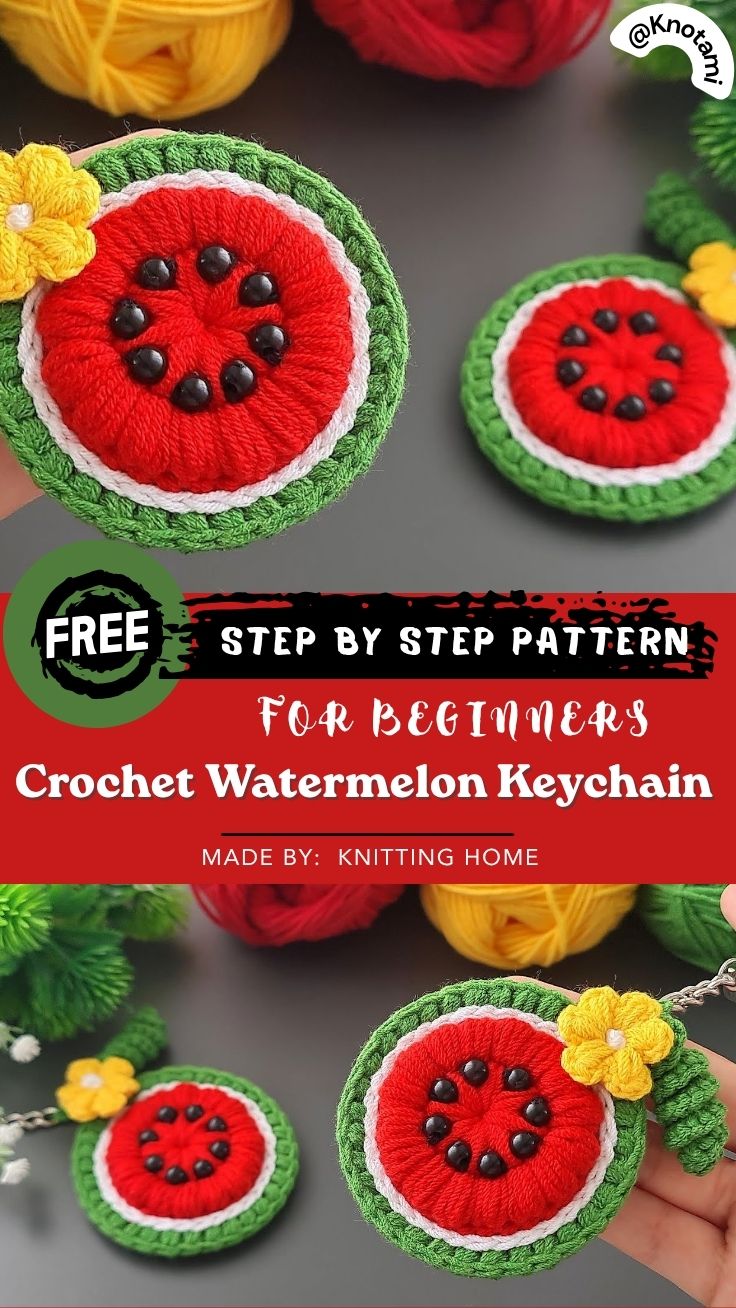
Pattern Overview
- Construction: Two flat half-circle pieces worked in turned rows, then seamed together.
- Shaping: Each row adds 3 stitches, with 9 rows per piece.
- Colors: A red center, a white band, a green rind, and black seeds.
- Finished width: About 5 cm (2 inches), depending on your yarn and hook.
- Time: About 1.5 to 2 hours in total.
Materials
- Yarn: Sport or DK-weight cotton in red (or pink), white (or cream), green, and black. Leftovers are enough.
- Crochet hook: 2.5 mm, or one to two sizes smaller than your yarn label suggests.
- Tools: Two stitch markers, a yarn needle for seaming, and a sharp embroidery needle for the seeds.
- Hardware: A split ring, plus a key ring, lobster clasp, or bag clip.
- Optional: A tiny wisp of fiberfill, or a felt cutout slightly smaller than the slice.
The seeds are embroidered rather than made with beads or safety eyes, since small loose parts and young children don’t mix.
Abbreviations (US Terms)
- MR – magic ring
- ch – chain
- sc – single crochet
- inc – increase (2 sc in the same stitch)
- sl st – slip stitch
- st(s) – stitch(es)
- FO – fasten off
Key Techniques
- Magic ring: Wrap the yarn around your fingers, work into the loop, then pull the tail until the center closes. Keep the tail on the wrong side.
- Color change: Work the last stitch of the row until two loops remain, pull the new color through both, and cut the old yarn with a 10 cm (4 inch) tail.
- Straight-stitch seeds: One short stitch, about a stitch long, pointing toward the magic ring. A two-wrap French knot also works.
- Whip stitch: Pass the needle through the outer loops of both layers, pulling just snug enough for the yarn to sink into the fabric.
Before You Start
Tension matters a lot on a flat charm. If your needle tip slides easily between two stitches, go down a hook size. Holding the piece up to a window helps too, since tiny spots of light mean stuffing could show through later.
Clip one marker into the first stitch of Row 7 and another into the first stitch of Row 8. These are the first stitches after each color change, where counts slip most easily. Leave 10 cm tails at every color change instead of weaving them in, since you’ll use them to seam their own stripes later.
How to Crochet the Watermelon Keychain
Each row holds 3 times its row number in stitches, so Row 4 has 12 stitches and Row 9 has 27. The ch 1 at the start of each row doesn’t count, and the first stitch always goes into the first stitch, never the chain. The increases fall at the end of each repeat, and because you turn every row, they switch sides, which keeps the straight edge straight.
Make two identical pieces following Steps 1 and 2.
Step 1: Crochet the Red Center
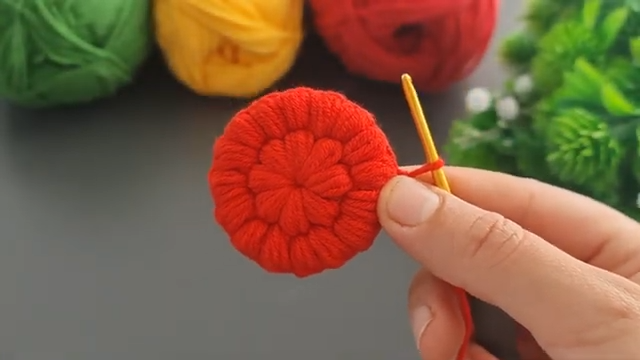
- Row 1: With red, MR, ch 1, work 3 sc into the ring. Pull the tail snug. Ch 1, turn. (3 sts)
- Row 2: Inc in each st. Ch 1, turn. (6 sts)
- Row 3: *1 sc, inc* 3 times. Ch 1, turn. (9 sts)
- Row 4: *2 sc, inc* 3 times. Ch 1, turn. (12 sts)
- Row 5: *3 sc, inc* 3 times. Ch 1, turn. (15 sts)
- Row 6: *4 sc, inc* 3 times, changing to white on the last stitch. (18 sts)
Step 2: Add the White Band and Green Rind
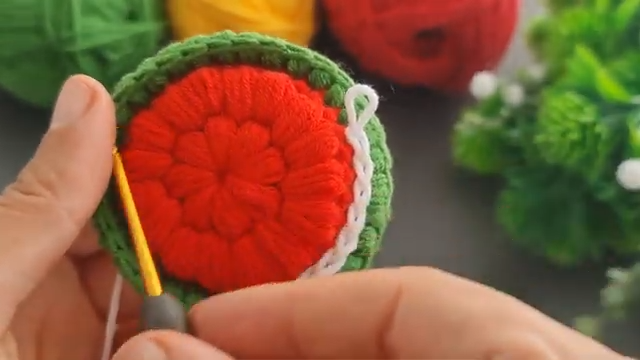
- Row 7: With white, ch 1, turn. *5 sc, inc* 3 times, changing to green on the last stitch. (21 sts)
- Row 8: With green, ch 1, turn. *6 sc, inc* 3 times. Ch 1, turn. (24 sts)
- Row 9: *7 sc, inc* 3 times. (27 sts) Fasten off, leaving a long green tail for seaming.
Tip: Count each row before you change color. Switching one stitch early leaves a notch in the stripe, and the only fix is ripping back. After each color change, pull the first stitch snug, since it’s always the loosest and the most likely to leave a gap.
Step 3: Embroider the Seeds
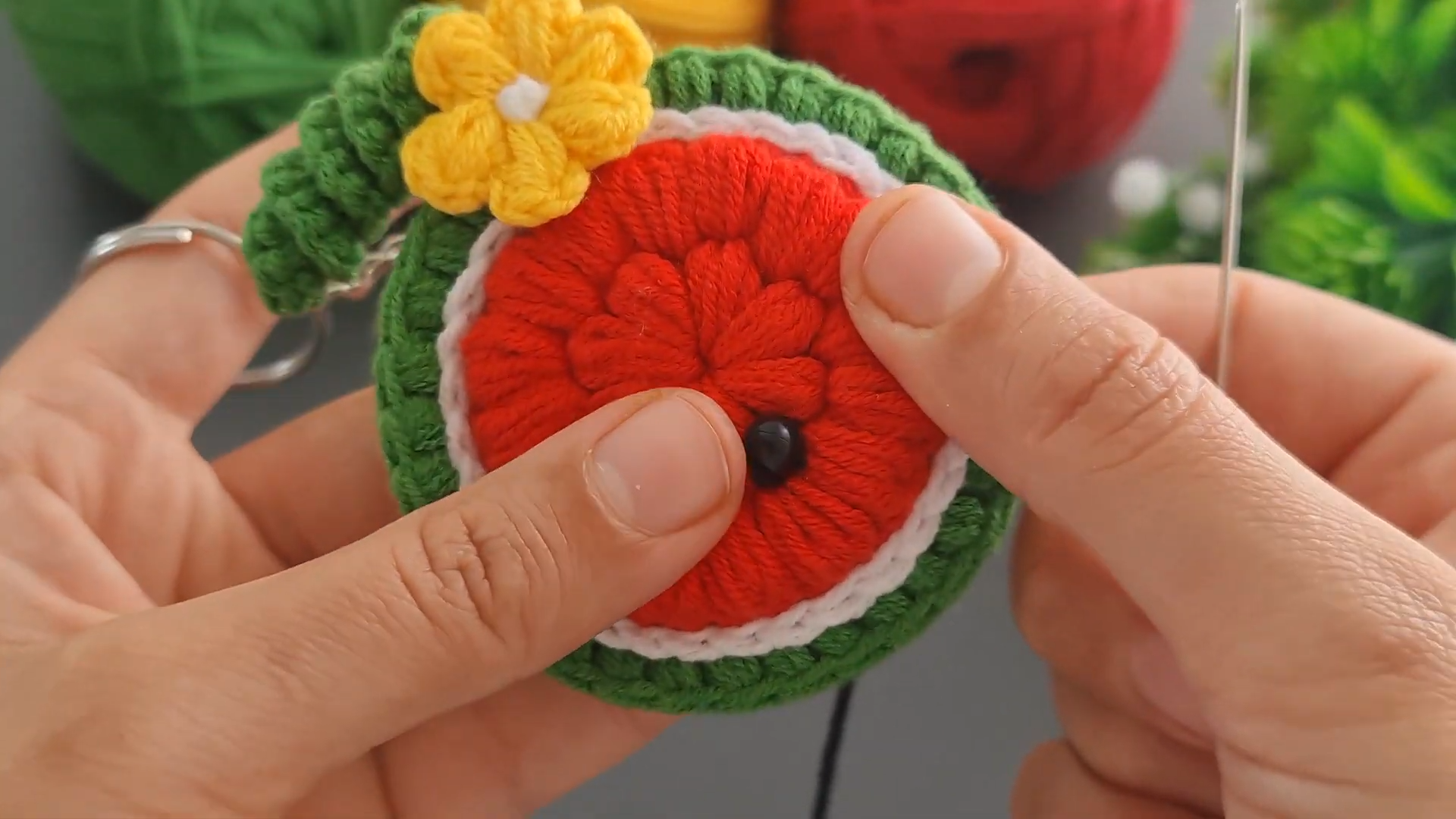
Add the seeds before joining the pieces so the knots stay hidden between the layers. The magic ring marks the center, and each seed should have a twin the same distance away on the other side. Count out from the ring and mark these spots on each piece:
- Row 3: Stitches 3 and 7.
- Row 5: Stitches 3, 8, and 13.
Work five short black straight stitches, each pointing toward the ring, and knot them on the wrong side. Repeat the same layout on the second piece so both sides look finished.
Keep seeds off Rows 1 and 2, which are too crowded, and off Row 6, so a strip of red sits beside the white band. Stay at least two stitches from the row ends, since the seam covers anything closer.
Step 4: Join the Two Halves
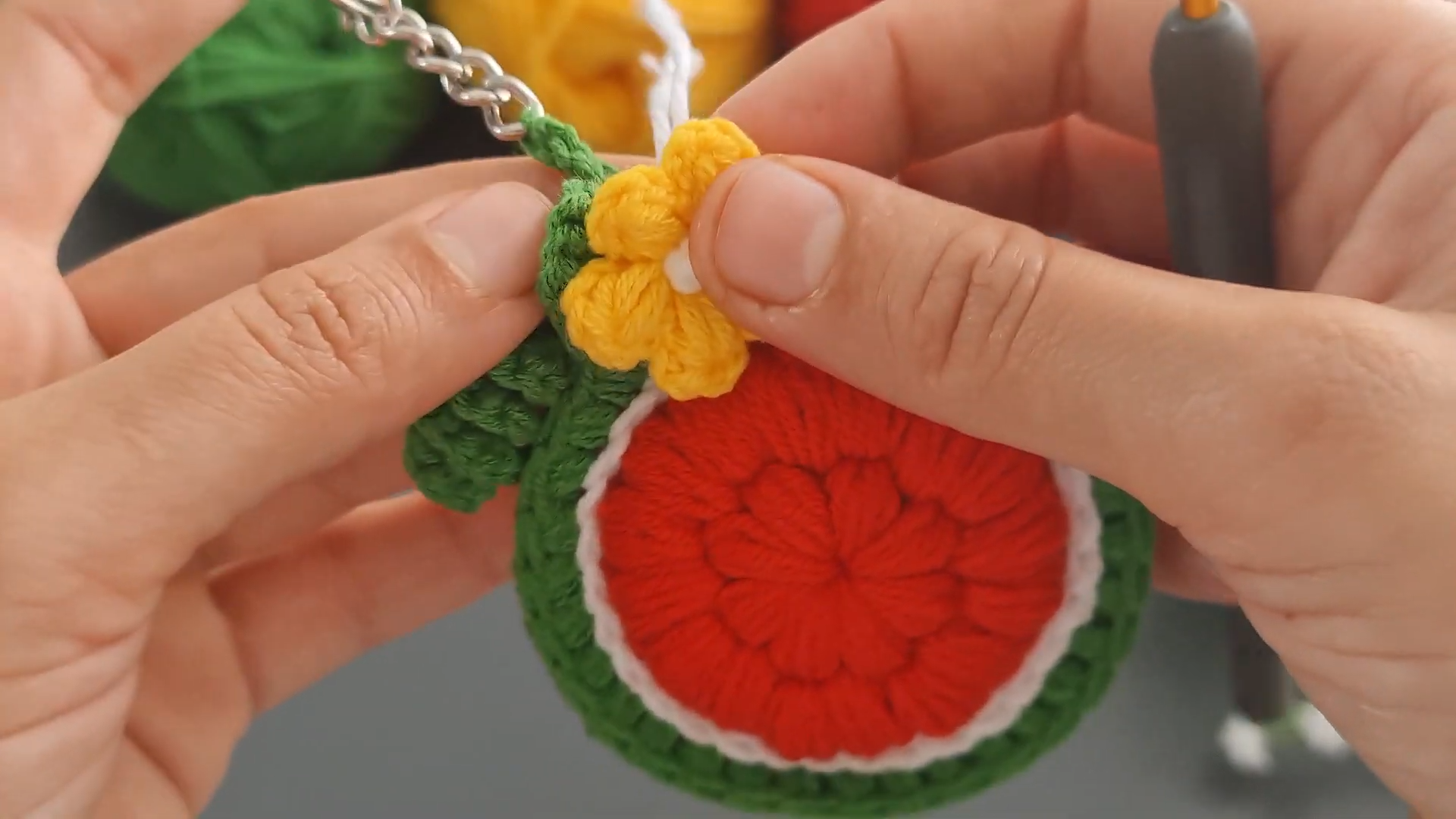
- Place the two pieces wrong sides together, with the stripes lined up and the magic rings meeting at the top center.
- Whip stitch the curved edge with the green tail from Row 9.
- Seam the straight edge using the color-change tails, each on its own stripe.
- Before closing the last few stitches, slip a pea-sized wisp of fiberfill or the felt cutout between the layers. A flat charm needs very little. If the slice puffs up when you press it, take some out.
Step 5: Add the Eyelet and Keyring
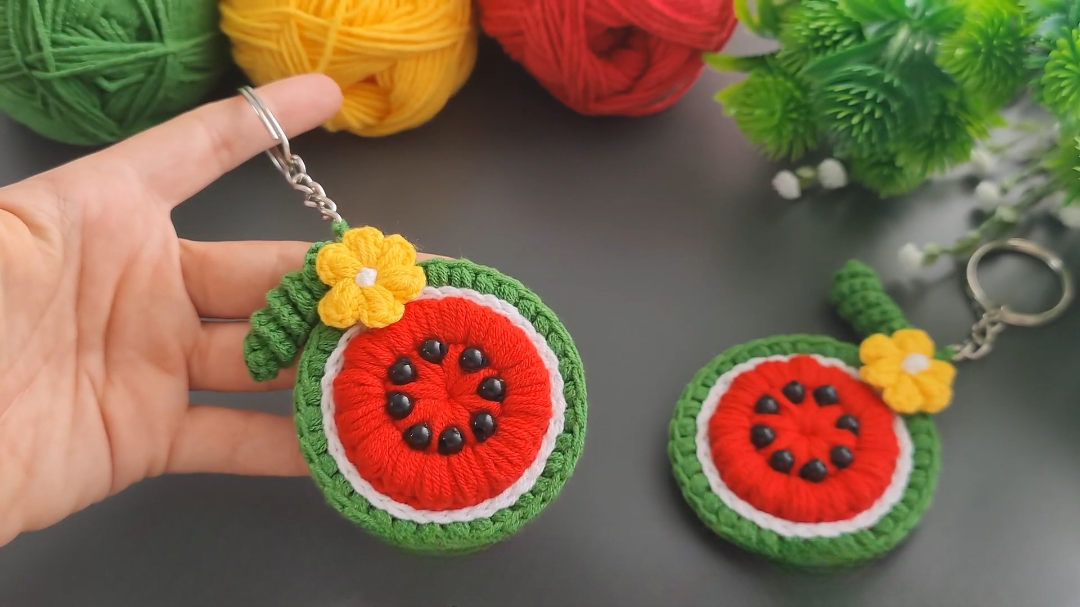
- At the top center, where the magic rings meet, push your hook through both layers and pull up a loop of green, leaving a 10 cm tail.
- Ch 6, then sl st into the same spot to form a loop.
- Work 8 sc into the loop, sl st to the first sc, and fasten off. Tuck both tails between the layers.
- Twist a split ring through the eyelet, then add a key ring or lobster clasp.
Placing the eyelet at the top center lets the slice hang evenly. An off-center eyelet tilts the slice and strains one side of the seam. Before gifting, test it by pulling the ring down, then to each side, then twisting. The eyelet should hold its shape without any stitches opening.
Video Tutorial
Stitch Count Checkpoints
- Row totals run 3, 6, 9, 12, 15, 18, 21, 24, and 27.
- Every row should be a multiple of 3. If it isn’t, you’ve dropped or added a stitch, usually the first stitch after a turn or the last one before it.
- Both pieces should finish with 27 stitches over 9 rows.
Common Mistakes to Avoid
- Working into the turning chain: It adds a stitch and bends the edge.
- Skipping the last stitch of a row: The edge ends up slanted.
- Changing color too early: It leaves a notch in the stripe.
- Overstuffing: The slice puffs up instead of staying flat.
- A weak eyelet: Always anchor it through both layers.
Troubleshooting
- Piece curls into a bowl: A row is missing an increase. Rip back to the last row with a correct multiple of 3.
- Edge ruffles: An extra increase slipped in. Recount and rework that row.
- Gap at a stripe: The first stitch after the color change was loose. Pull it snug as you work.
- Red staining the white: Before you start, press a damp red strand on a white paper towel. If the color bleeds, switch yarn.
- Loose eyelet: Redo it with a second pass through both layers.
Size and Color Variations
- Mini charm: Use thinner yarn and a smaller hook, and work 7 rows: red for Rows 1–4, white for Row 5, and green for Rows 6–7. (21 sts)
- Bag-size slice: Use heavier yarn and a larger hook, or work 12 rows: red for Rows 1–8, white for Row 9, and green for Rows 10–12. (36 sts) Add a felt insert to keep it flat.
- Soft look: Pink flesh with a cream band.
- Yellow watermelon: Yellow flesh with black seeds.
- Two-tone rind: Light green for Row 8 and dark green for Row 9.
Make a Fruit Charm Set
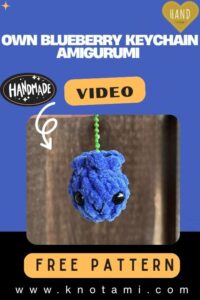
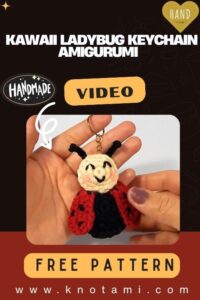
One slice looks sweet, but a little collection of fruit charms makes an even better gift. Pair your watermelon with a crochet blueberry keychain, then hang them together on one ring or package them as a summer set. Tuck each charm into a small kraft envelope for party favors, or slot it through a folded card with a short care note on the back. For more bright bag charms, try this crochet kawaii ladybug keychain.
Ways to Use Your Slice
- Keychain: Loop it onto a key ring for everyday use.
- Bag charm: Clip a lobster clasp to a tote strap or backpack loop.
- Zipper pull: Add a light split ring to a pencil case or jacket zipper.
- Mini ornament: Swap the ring for a ribbon loop and hang it on a summer wreath.
This slice is a decorative accessory, not a toy. Keep it away from babies, toddlers, and pets that might chew hanging charms.
Finishing and Care
Weave any remaining tails into the seam. Pin the slice flat, mist it lightly with water, and let it dry flat to straighten the edge. Keep steam away from the metal hardware.
Spot clean with a damp cloth and a drop of mild soap, and keep the hardware dry to prevent rust. Air dry the slice flat, away from heat and strong sunlight, since red tends to fade first.
Frequently Asked Questions
Can I use acrylic instead of cotton?
Yes, but acrylic stretches more, so go down a hook size and expect slightly softer stripe edges.
Do I need stuffing?
Rarely. Dense stitches hold the shape on their own, and a felt cutout adds firmness without bulk.
Can I use beads for the seeds?
Embroidered seeds are the safer choice, since beads can come loose and become small parts.
Which hardware holds up best for a heavy set of keys?
A split ring with a key ring is sturdier than a clasp. Save lobster clasps for bags.
Final Notes
This crochet watermelon keychain turns a few yarn scraps into a cheerful summer charm. Crochet the two striped halves, stitch the seeds, join them, add the eyelet, and your slice is ready for your keys, bag, or a friend’s gift.