Half Double and Double Crochet for Beginners
Single crochet is sturdy but slow. Taller stitches cover more ground, drape more softly, and show up in nearly every garment pattern. Half double and double crochet are the next two stitches to learn, and both build on moves you already know.
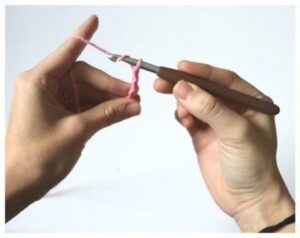
You’ll need a chain of twenty, a 5 mm (H-8) hook, and worsted yarn. Keep the single crochet lesson handy for comparison.
How Tall Is Each Stitch?
Think of stitch height as a staircase. Single crochet is one low step. Half double crochet (hdc) is a step and a half. Double crochet (dc) is two full steps. Their turning chains copy that height: one chain for sc, two for hdc, three for dc.
Half Double Crochet (hdc)
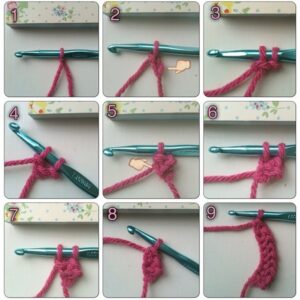
Step 1: Yarn Over First
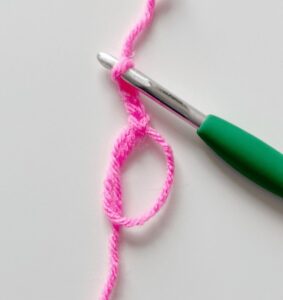
Wrap the yarn over the hook before you enter the stitch.
Step 2: Pull Up a Loop
Insert the hook, yarn over, and pull a loop through. Three loops sit on the hook.
Step 3: Close It
Yarn over once more and pull through all three loops at once.
For row one, put the first hdc into the third chain from the hook. At the start of later rows, chain two and turn. Many patterns don’t count that chain as a stitch, so follow the written directions each time.
Double Crochet (dc)
Half Double Crochet (hdc)
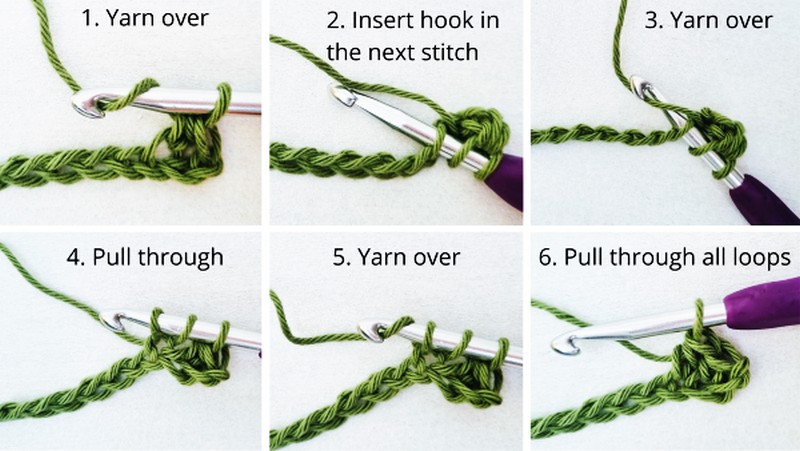
Step 1: Yarn Over
Wrap the yarn over the hook from back to front before you touch the stitch.
Step 2: Insert the Hook in the Next Stitch
Slide the hook under both top strands of the next stitch. The yarn-over loop stays on the hook.
Step 3: Yarn Over Again
Wrap the yarn over the hook once more so it sits ready to catch.
Step 4: Pull Through
Draw the hooked yarn back through the stitch only. Three loops now sit on the hook.
Step 5: Yarn Over Once More
Wrap the yarn over the hook one last time, keeping all three loops loose.
Step 6: Pull Through All Loops
Pull the yarn through all three loops at once. One loop remains, and the half double crochet is done.
For row one, put the first hdc into the third chain from the hook. At the start of later rows, chain two and turn. Many patterns don’t count that chain as a stitch, so follow the written directions each time.
For row one, work the first dc into the fourth chain from the hook; the three skipped chains count as your first stitch. Chain three and turn at the start of each following row. That chain counts as the first stitch, and the last stitch of the row goes into the top of the previous row’s turning chain.
A Quick Count Check
Chain twenty and work a dc into the fourth chain. Continue across. You’ll have seventeen dcs plus the turning chain standing in as one stitch, eighteen in total. After Row 2, you should still count eighteen.
Common Mistakes
- Pulling through three loops in a double. Always pull through two, then two.
- Forgetting the yarn over before entering. Without it the stitch collapses into something shorter.
- Missing the last stitch. Look for the top of the turning chain; it hides in the edge.
- Changing the turning chain count. Pick one pattern rule and stay with it row after row.
- Tight stitches. Tall stitches need slack; relax your grip.
Where Taller Stitches Show Up
Double crochet does most of the heavy lifting in the crochet high-waisted ruffle shorts pattern. Once rows feel steady, browse the Wearables category.
Bonus: Build a Sampler Strip
Chain twenty and work three rows of single crochet, three of hdc, and three of dc, without cutting the yarn. Hold the strip up to the light and you’ll see the three heights side by side, which is a handy reference for later.
FAQs About Taller Stitches
Does the turning chain count as a stitch?
For double crochet, usually yes. For half double, patterns differ, so check the notes.
Why do my edges slant inward?
You’re probably skipping the top of the turning chain at the end of the row.
Which is better for beginners, hdc or dc?
Dc is easier to see and count because each stitch stands tall.
Taller Stitches, Bigger Possibilities
With three heights in your toolkit, patterns stop looking mysterious. A blanket, a hat, or a tote bag is mostly a conversation between these stitches. Keep the sampler strip in your project basket and compare it whenever a stitch looks off.