How to Hold a Crochet Hook and Yarn for Beginners
A relaxed hand makes better stitches than a strong one. Knowing how to hold a crochet hook comfortably, before you learn a single stitch, protects your wrists and keeps every row even.
Most beginners squeeze the hook like it might escape. Tight fingers make tight stitches, and tired hands send plenty of newcomers back to the couch within a week. Below you’ll find two common grips, a simple way to guide the yarn, and the small habits that keep tension steady.
What You Need
- Smooth worsted-weight yarn in a light color, so stitches are easy to see
- A 5 mm (H-8) crochet hook
- A supportive chair and good light
A plain aluminum hook glides nicely. Ergonomic handles are optional, so try them only if your hand tires quickly.
Two Ways to Hold the Hook
The Pencil Grip
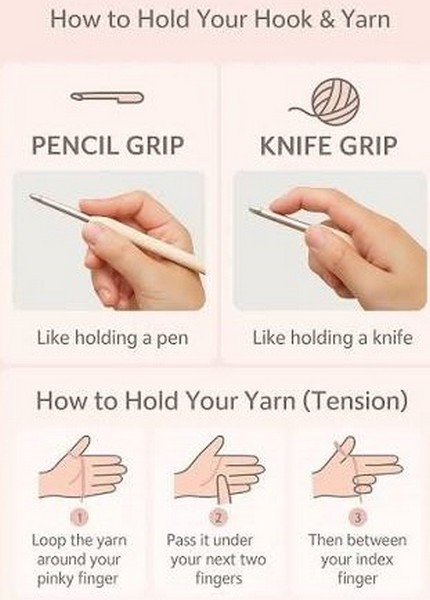
Hold the hook the way you’d hold a pencil. The flat thumb rest sits under your thumb pad, and your index finger rests on top. Keep your fingers near the flat spot instead of down by the throat. A loose hold lets the hook rotate a little as you work.
The Knife Grip
Hold the hook like a table knife, with your palm over the shaft and your thumb and index finger on the flat part. Some stitchers find it easier on the hand during big projects, and others find it clumsy. Give each grip five minutes before you pick a favorite.
In both grips, tilt the open throat of the hook so it faces you or tips slightly downward. A hook that points upward lets loops slip right off.
Holding the Yarn
The steps below are for right-handed stitchers. Left-handed readers can mirror everything, with the hook in the left hand and the yarn in the right.
Step 1: Start With a Loop
Any loop on the hook will do for practice. The next lesson, slip knot and chain stitch basics, shows how to make a proper one.
Step 2: Thread the Yarn Through Your Fingers
Let the yarn from the ball pass between your ring finger and little finger. Wrap it once around the little finger, lay it across the backs of your ring and middle fingers, then bring it up and over your index finger.
Step 3: Pinch the Work
Use the thumb and middle finger of your yarn hand to pinch the base of the work, right under the hook. Your raised index finger now controls how much yarn feeds out.
Step 4: Test the Flow
Tug the yarn gently. It should slide with a little resistance, like a taut thread. If it won’t move, unwrap one loop from your little finger.
Common Mistakes
- Death grip. Shake your hands out every few minutes and hold the hook lighter than feels natural.
- Holding too low. Fingers crowding the throat make it hard to turn the hook. Move up to the flat spot.
- Yarn wrapped too tightly. Stitches turn stiff, and the hook fights back. Remove a wrap.
- Frozen shoulders. Drop them, rest your elbows, and breathe.
Your First Practice Session
Spend ten minutes just making loose loops and pulling yarn through them. No counting, no pattern. Once the grip feels familiar, move on to something small and flat, such as the crochet cat coaster, or browse the Crochet for Beginners section.
Bonus: Three-Minute Hand Warm-Up
Open and close your fists ten times. Roll each wrist in slow circles, five each way. Spread your fingers wide, hold for five seconds, and repeat three times. Stop if anything hurts, and rest longer between sessions.
FAQs About Holding a Crochet Hook
Does it matter which grip I use?
No. Choose the grip that lets you work without strain, and switch if your hand starts to ache.
Can left-handed people learn from right-handed videos?
Yes. Hold a mirror next to the screen, or look for tutorials filmed for left hands.
Why does my yarn keep slipping off my fingers?
Slippery yarn needs one extra wrap around the little finger. Cotton or wool grips better than silky acrylic.
Settle In and Start Stitching
Nobody picks up a hook and looks graceful on day one. Your grip will loosen, your tension will even out, and the awkward hand position will start to feel like your own. Keep the first sessions short, and let comfort lead.