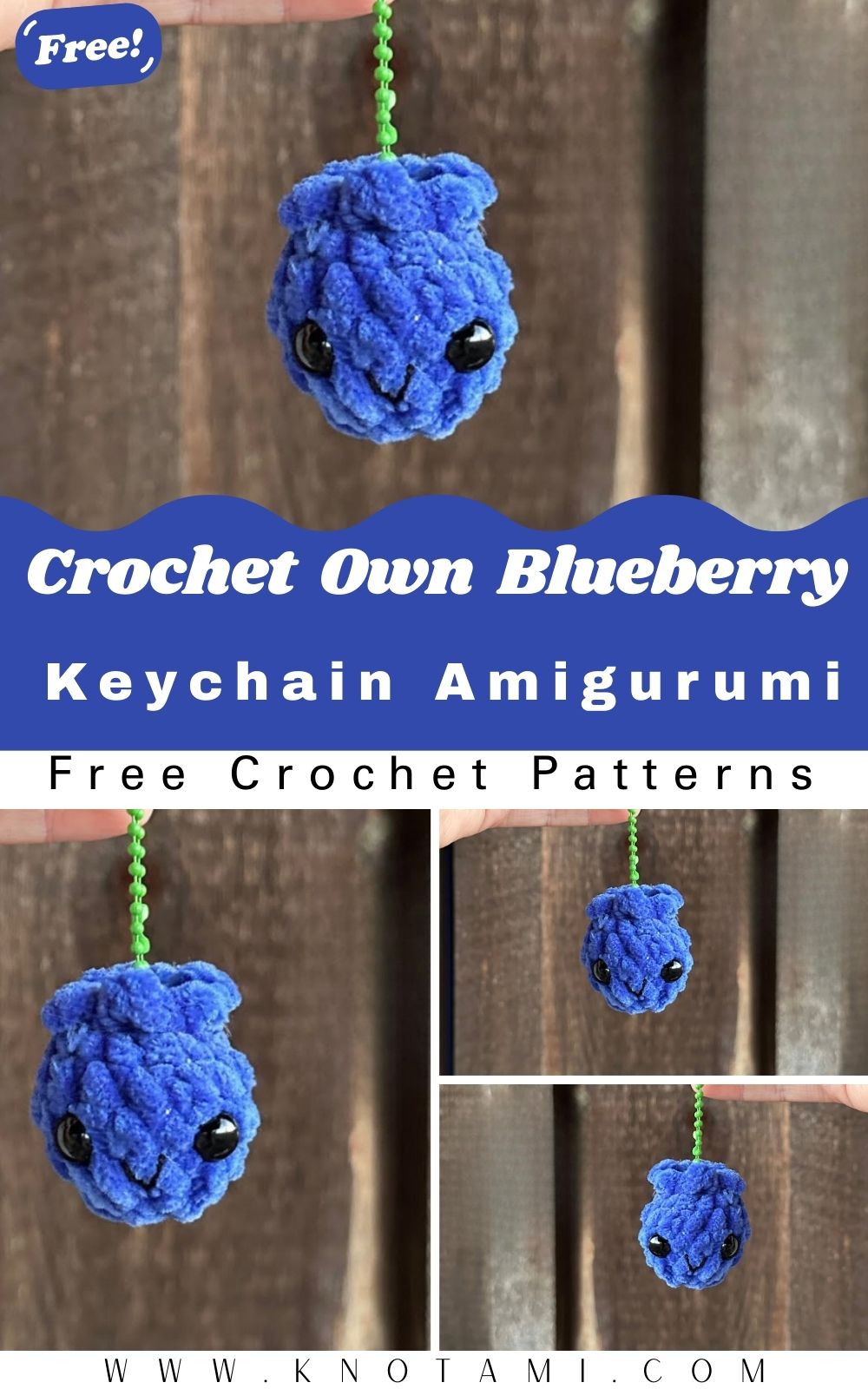
Crochet Blueberry Keychain Amigurumi Pattern For bags
Round dusty-blue and small enough to close inside a palm a stitched berry takes shape row by row in the Crochet Blueberry Keychain Amigurumi Pattern for Bags a quick portable charm built to clip onto a strap zipper or set of keys.
Beyond the cute shape a blueberry amigurumi keychain works as a fast low-yardage project suited to market prep, stash-busting, or building a matching set of fruit charms. Worked in continuous single crochet rounds with a lightly stuffed body and a small crown detail at the top, the mini crochet fruit design holds up well to daily handling on a bag or keyring.
Pattern Overview
A blueberry keychain is built from one main round body, plus a small blossom-end (crown) detail worked either directly into an earlier round or crocheted separately and attached. Once stuffed and closed, keychain hardware a jump ring and clasp, or a crocheted loop gets sewn on at the top. No garment shaping is involved; the whole project lives or dies on tight, even, small-scale tension.
Style and Look
Most blueberry keychains online use a single dusty-blue or blue-purple body with a slightly darker or contrasting crown at the blossom end, since that two-tone crown is the detail that reads as “blueberry” rather than a generic ball. A few patterns add a tiny embroidered face; plenty skip it entirely for a plain-fruit look. Typical build for the style: plain fruit body with a contrast-color crown, no face. (Cross-check against the video.)
Time Box
Comparable blueberry amigurumi patterns list roughly an hour of total working time for an experienced amigurumi crocheter. Pace varies with hook size and yarn weight on such a small project — treat the split below as a typical reference and time your own pace as you work.
- Prep (reading pattern, gathering supplies, test swatch): ~5–10 minutes
- Stitching (body + crown): ~35–45 minutes
- Finishing (stuffing, closing, hardware, weaving ends): ~10–15 minutes
Finished Size (per keychain)
Small fruit keychains in the style commonly land somewhere around 4–5 cm / 1.5–2 in across (roughly coin-sized), based on similar published patterns. Check your own piece against a coin or ruler once stuffed and closed, and adjust the figure above to match.
Materials
Yarn/thread weight: Sport/DK weight (weight 2–3) cotton or cotton-blend is typical for the style fine enough to keep the crown detail crisp, sturdy enough to hold shape on a keyring. Cross-check the exact weight against the source video.
Yarn/thread quantity: Roughly 5–10 g of main color plus a small scrap of contrast color for the crown well under one full skein. Confirm exact yardage once you’ve worked a test piece.
Hook size: 2.5mm is a typical starting point for sport/DK cotton on such a small piece (a step smaller than the yarn label usually recommends, to keep stitches tight). Confirm against the source video and adjust if your tension runs loose or tight.
Gauge: No formal gauge swatch is standard for amigurumi at such a small scale fit isn’t the concern, stitch tightness is. Tension note: if stuffing shows through your stitches, drop down a hook size before continuing.
Additional Supplies
- Polyester fiberfill stuffing
- Stitch marker (essential continuous rounds have no natural row marker)
- Tapestry/yarn needle
- Scissors
- Keyring or lobster clasp, plus a jump ring
- Small pliers (to open and fully close the jump ring)
- Safety eyes or embroidery thread optional, if adding a face
Abbreviations
MR (magic ring) · sc (single crochet) · inc (increase, 2 sc in same st) · dec (invisible decrease/sc2tog) · st(s) (stitch(es)) · rnd(s) (round(s)) · sl st (slip stitch) · FLO (front loop only) · FO (fasten off)
Important Stitches
- Magic ring – start point for the body
- Single crochet, worked in a continuous spiral – no joining slip stitch between rounds; use a stitch marker to track the start of each round
- Increase/decrease – shapes the round body from the magic ring out to its widest point, then back in to close
- Front loop only (FLO) row – several published blueberry patterns use an FLO round partway up the body to create the raised, star-shaped blossom crown at the top; the pattern below follows that typical approach, worked into the front loops of an early round. Confirm against the source video whether the crown is worked that way or crocheted separately.
Before You Start
Read the full pattern once before picking up your hook. Work a few practice rounds first to check your tension holds tight enough that stuffing won’t peek through. Small-scale amigurumi is far less forgiving of loose stitches than a full-size plush.
How the Keychain Is Constructed
The body starts at a magic ring, increases out to its widest point, works several straight rounds, then decreases back down toward the top. The crown/blossom detail is added at or near the top either worked into the front loops left from an earlier round, or crocheted flat and stitched on afterward. Stuffing goes in before the final rounds close, and keychain hardware attaches once the piece is fully fastened off.
Step-by-Step Pattern
1. Starting the Body (Magic Ring & Increases)
Begin with a magic ring and work your first round of single crochet into it. Typical progression for a berry at keychain scale:
- Rnd 1: 6 sc in MR (6 sts)
- Rnd 2: inc around (12 sts)
- Rnd 3: (sc 1, inc) around (18 sts)
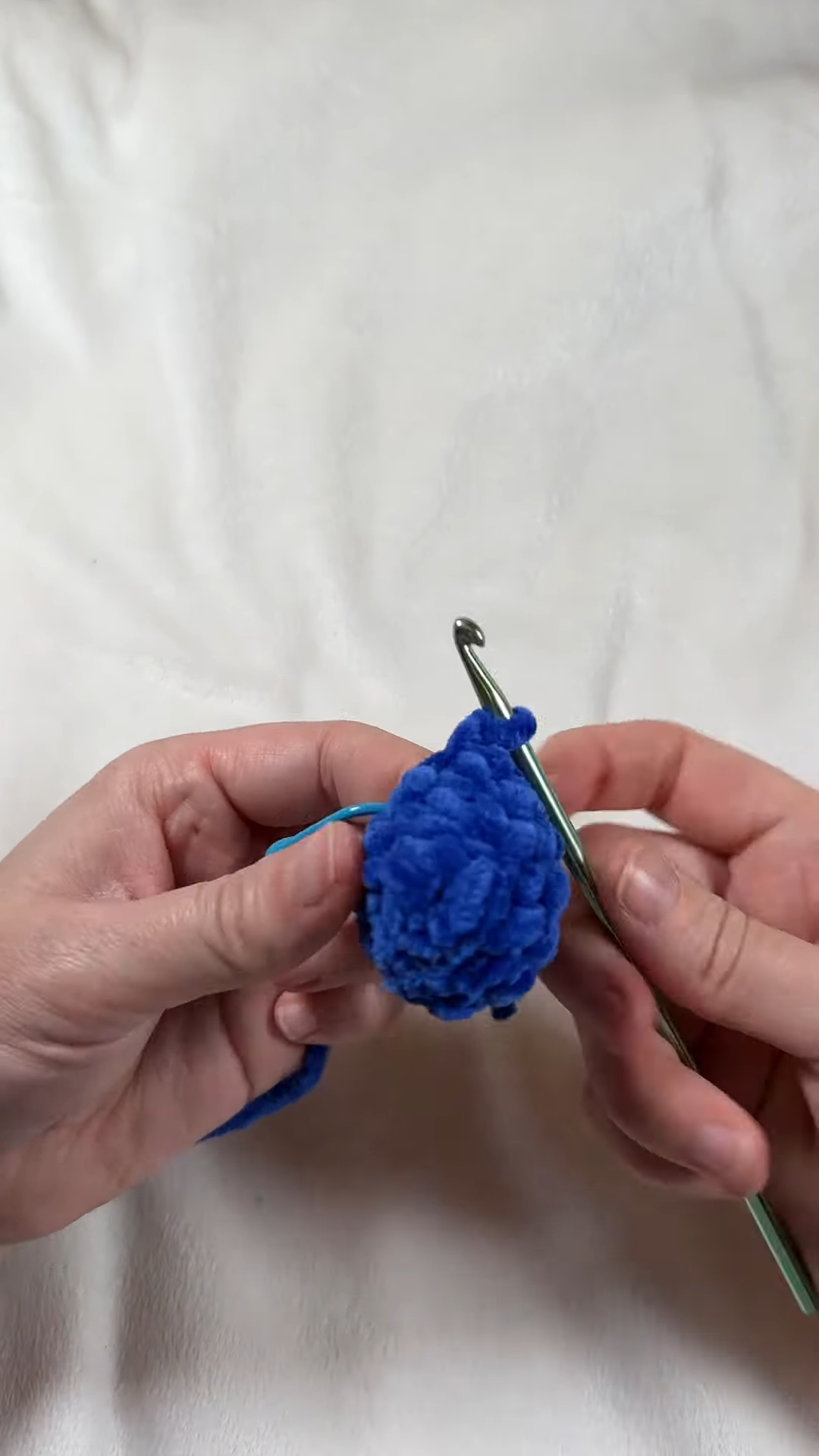
First, start by creating a magic ring with your blue yarn. This is the standard beginning for any easy amigurumi. Inside that magic ring, crochet eight single crochet stitches. Once finished, pull the thread tight to close the center hole. Make a slip stitch into the first stitch to join the round, followed by one chain stitch to prepare for the next level.
Phase 2: Expanding the Shape
In the second row, the goal is to expand the circle. You will perform eight increases by putting two single crochets into every stitch. However, a key detail here is to crochet only in the back loops. This creates a specific texture that helps the blueberry look more authentic. By the end of this row, you should have sixteen stitches. Close the row with a slip stitch and a chain.
Phase 3: Building the Height
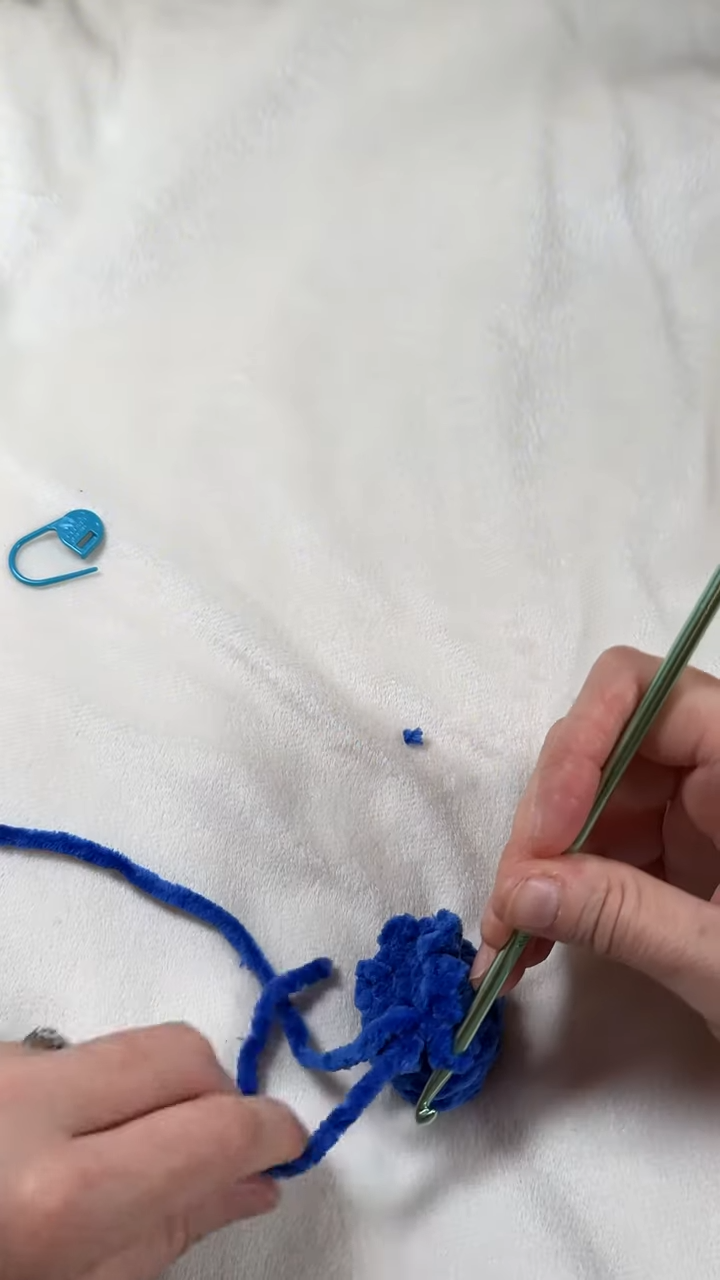
Now that you have your width, you need to build the body. For rows three, four, and five, simply crochet sixteen single crochet stitches in each round. This “even” stitching allows the flat circle to curve upwards into a cup shape. Remember to close each row with a slip stitch to keep your work neat. At this stage, your project will start looking like a tiny blue bowl.
Phase 4: Decreasing and Stuffing
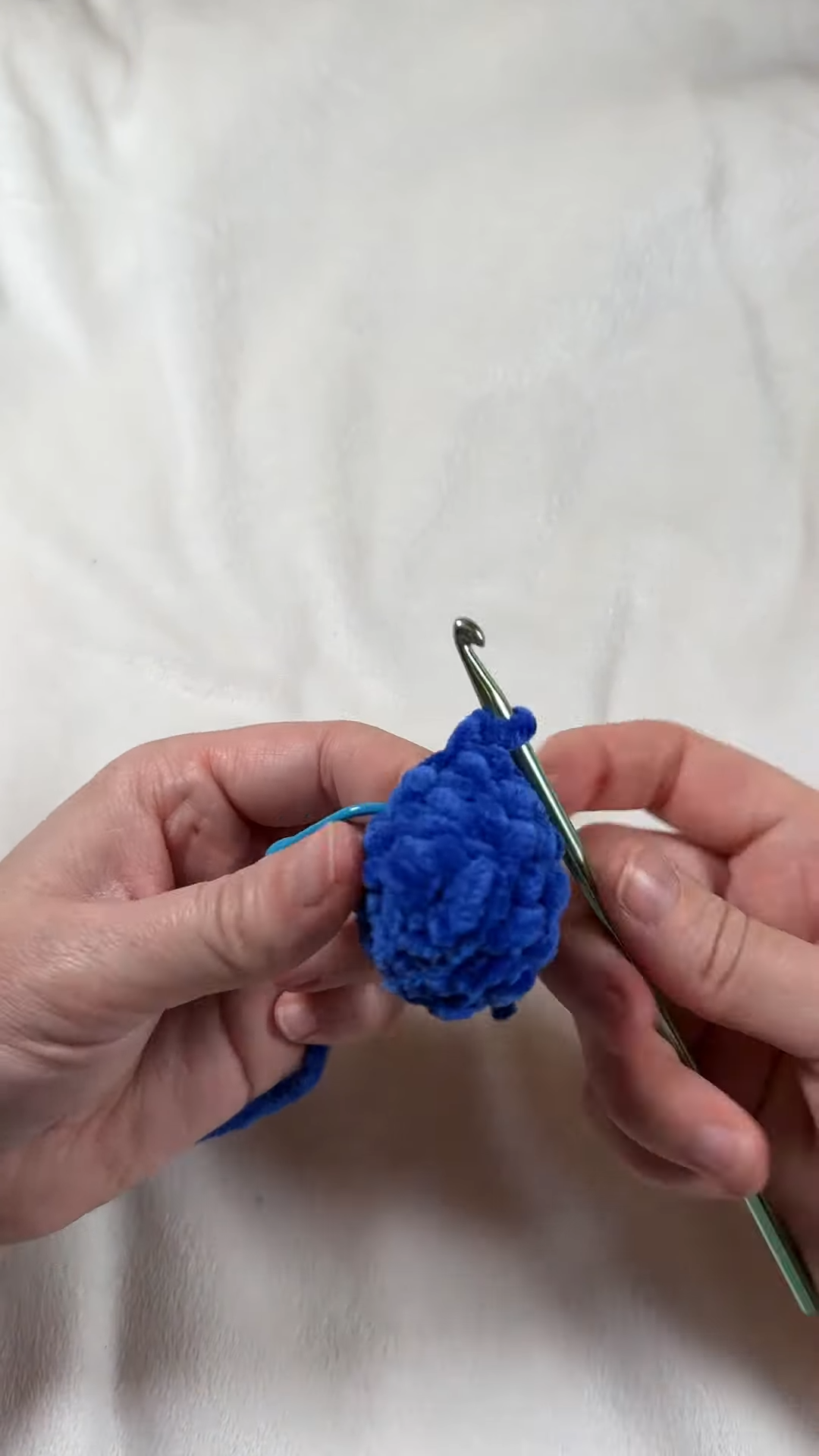
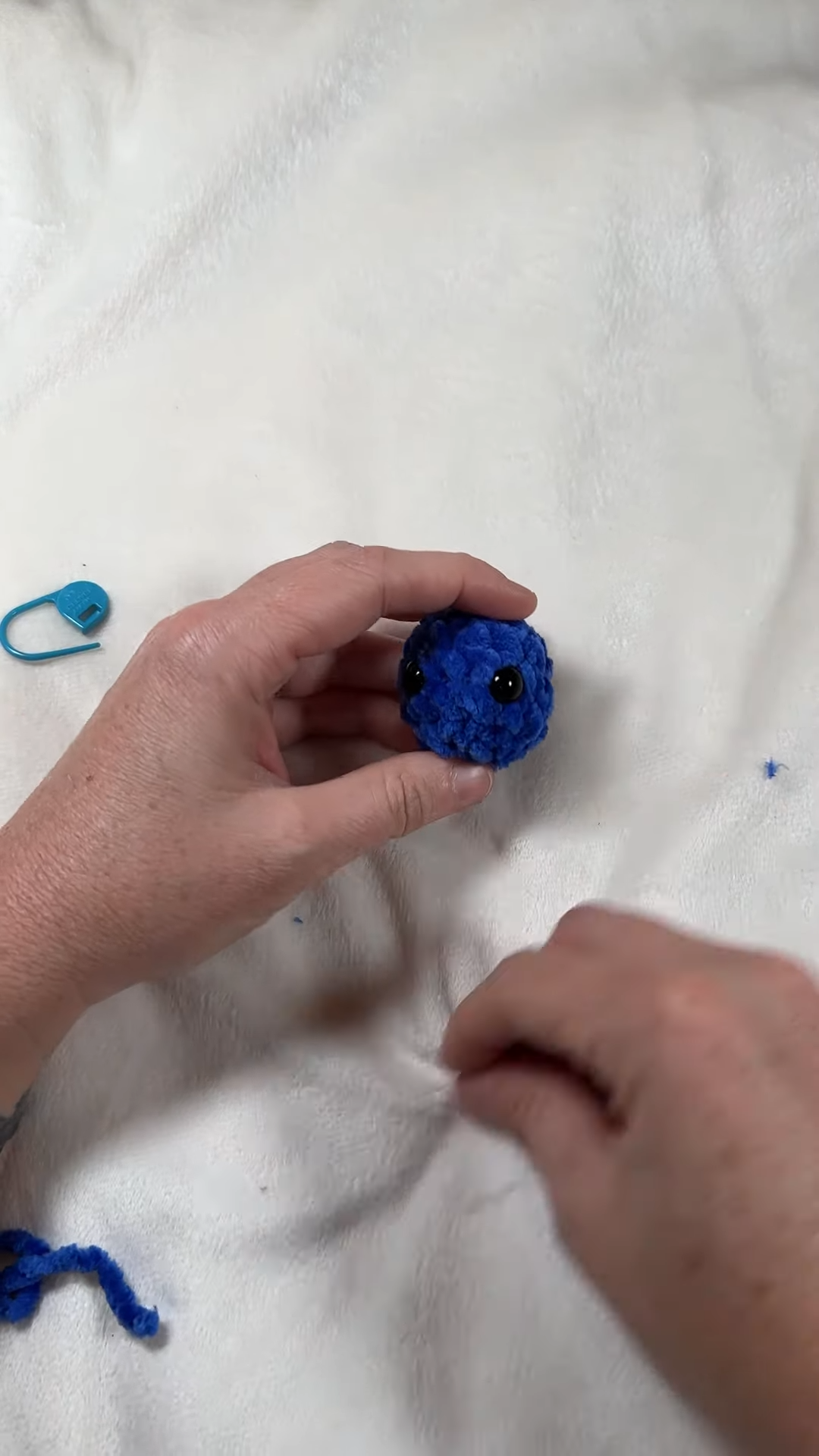
After completing the height, it is time to close the berry. In row six, you will perform eight decreases. This means you will crochet two stitches together eight times until the opening is small. Before you close it completely, add your fiberfill. Use your fingers or a hook to push the stuffing inside until the berry is firm. Once stuffed, cut the thread, leave a long tail, and use your needle to pull the hole shut.
Phase 5: Adding the Blueberry Crown

To finish, return to the front loops you left at the top center. Attach your yarn and create a pattern of three chains followed by a slip stitch in the next stitch. Repeat this around the center to create a ruffled “crown” effect. Finally, hide all your loose threads inside the body. Attach your keychain ring, and your masterpiece is complete
Watch The Video Tutorial
Where Can You Use Your Blueberry?
Once finished, you will realize just how versatile this little item is. Primarily, it serves as a wonderful keychain that makes your keys easier to find in a crowded bag. Because of its bright color and soft texture, it stands out visually. Moreover, you can attach these blueberries to zippers on backpacks or pencil cases to add personality to your gear.
Besides being a keychain, these mini blueberries work perfectly as “bag charms” or desk decor. You could make a whole bowl of them to sit on your workspace as a stress-reliever. Additionally, they make excellent small gifts for teachers or friends. Since they are so quick to make, you can easily produce a dozen for craft fairs or party favors.
Tips and Tricks for Perfect Amigurumi
To ensure the best result, always check your stitch count at the end of every row. It is easy to accidentally skip a stitch, which can make the blueberry look lopsided. Furthermore, when stuffing the berry, avoid overstuffing to the point where stitches stretch. A firm but slightly squishy berry is the ideal goal.
Another great trick is to use “invisible decreases” instead of standard ones. This technique makes the closing of the berry look much smoother. Also, if you want a “frosted” look, choose a yarn with a matte finish. By experimenting with different shades of blue and purple, you can create a diverse harvest of berries.
Common Mistakes to Avoid
One common mistake is forgetting to work in the back loops during the increase row. If you crochet through both loops, you lose the ridge that adds character to the fruit. Additionally, many beginners struggle with hiding yarn tails. If you simply cut the yarn short, the berry might eventually unravel with heavy use.
Another error is using a hook that is too large for the yarn weight. If your hook is too big, the stitches will be loose and the white fiberfill will show through. This takes away from the “solid” look of the fruit. Lastly, do not skip the “crown” step. That tiny detail is what truly transforms a blue ball into a recognizable blueberry.
Frequently Asked Questions (FAQs)
Can I use a different type of yarn like acrylic?
Yes, but cotton is usually preferred for keychains. If you use acrylic, ensure the hook size matches the yarn thickness so stitches stay tight.
How long does it take to crochet one blueberry?
It usually takes about 20 to 30 minutes. Because the rounds are small, it is an extremely fast project.
Do I really need a 1.6 mm hook?
A 1.6 mm hook is great for a tight finish, but you can use a 2.0 mm hook instead. Just keep in mind that a larger hook will result in a slightly larger blueberry.
How do I clean my crochet keychain?
Gently hand wash the blueberry with mild soap and cool water. Let it air dry completely so the stuffing doesn’t stay damp.
Is this project suitable for children?
Absolutely! This is an excellent project for older children or teenagers. The steps are repetitive and easy to follow.