Adorable Crochet Panda Amigurumi Pattern for Good Vibes
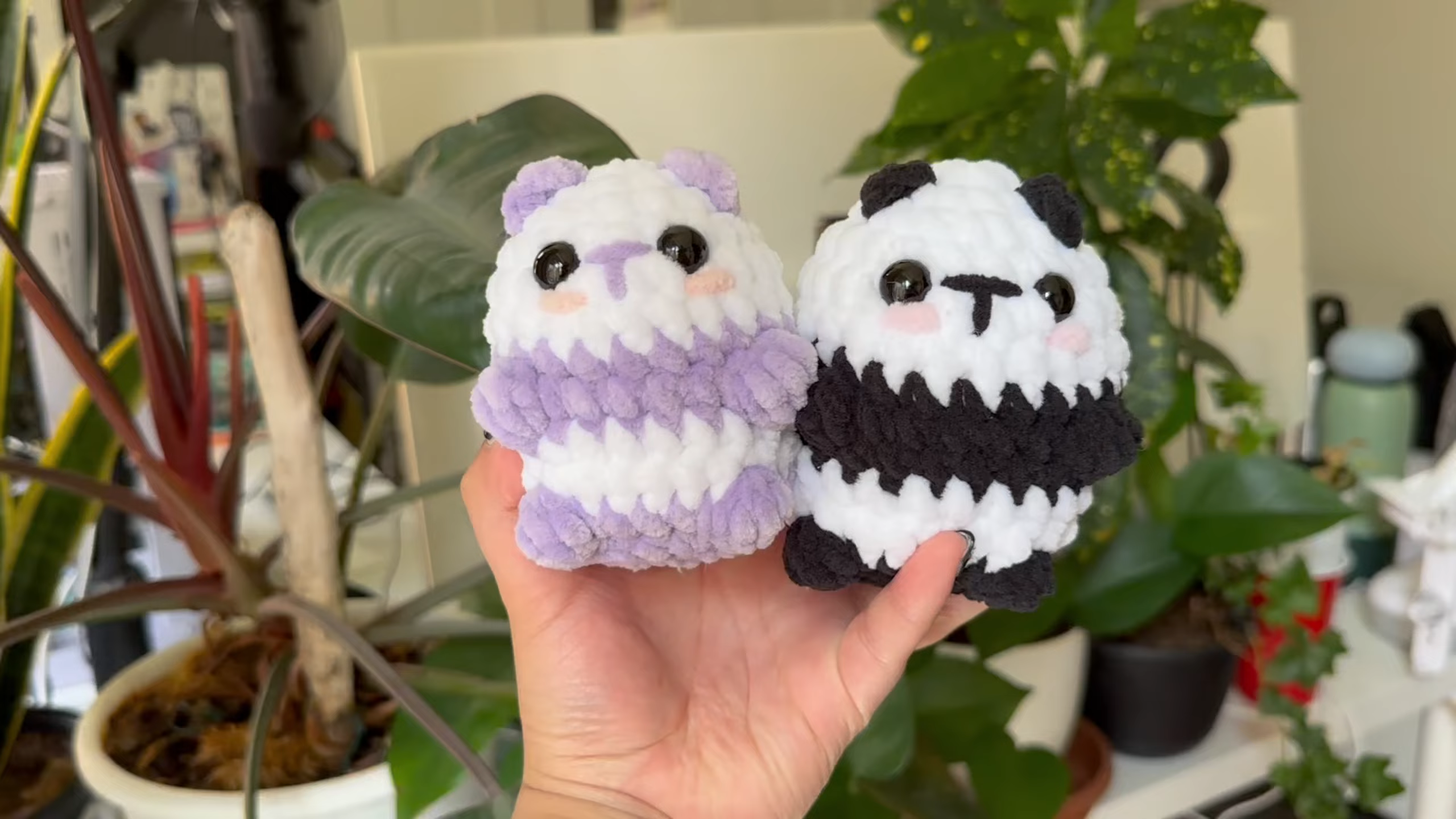
Velvety lavender swirls and a round white face give this adorable crochet panda amigurumi pattern for good vibes its instant charm. The chubby little plushie brightens a desk or bedside shelf, and it comes together as a relaxing beginner project in a single evening.
What sets this panda apart is its one-piece build. The head and body flow together in a single spiral, so the only sewing is for the ears and arms. The diagonal swirl across the middle comes from plain single crochet color changes shifted by one stitch each round, and soft chenille yarn hides small tension slips while giving the plush its squeezable, velvety feel.
What You’re Making
The finished panda stands roughly 6 inches tall in super bulky chenille. It has a snowy white head, a lavender and white swirl across the middle, a narrow white band and a lavender base. Two small rounded ears sit on top, and two stubby arms hug the sides.
Everything is worked in continuous rounds from the top down. You stuff near the end and close the bottom last, and the chubby, egg-like shape stands up on its own.
- Skill level: Beginner. If you can make a magic ring and single crochet in the round, you’re ready. Only the swirl rounds need extra attention.
- Time: About 10 minutes of prep, 1.5 to 2 hours of stitching, and 20 to 30 minutes for the ears, arms and closing
Materials and Supplies
- White: Super bulky chenille or velvet yarn (weight 6), about 45 yards
- Lavender: The same yarn, about 35 yards. Stick to one brand for both colors so the stitches match in thickness.
- Hook: 5 mm (H-8). An ergonomic handle helps, since chenille can grip the hook and tire your wrist.
- Eyes: One pair of 12 mm black safety eyes
- Other: Polyester fiberfill, a large-eye plastic yarn needle, sharp scissors, a bright stitch marker, and pins
Stitches and Abbreviations (US Terms)
- MR – magic ring
- sc – single crochet
- inc – increase (2 sc in the same stitch)
- dec – decrease (invisible decrease recommended)
- FO – fasten off
- W / L – sc in white / sc in lavender
- ( ) x6 – repeat the steps in brackets 6 times
- (12) – total stitch count at the end of the round
Step-by-Step Panda Pattern
Work in continuous spirals without joining, and move your stitch marker up every round.
Step 1: Start the Head in White
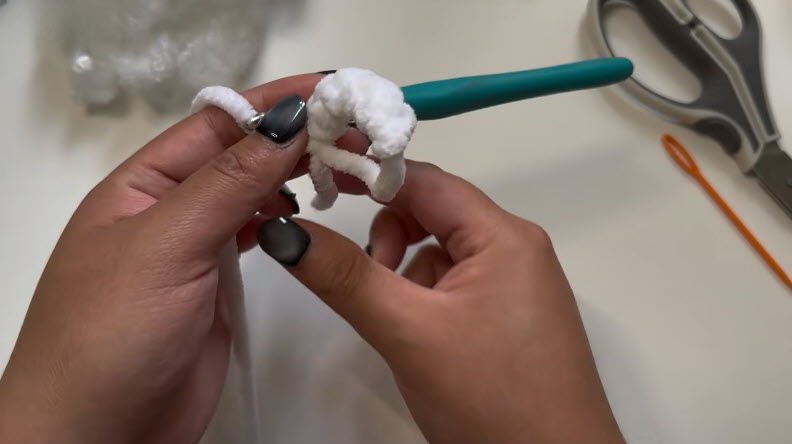
- R1: 6 sc in MR (6)
- R2: inc x6 (12)
- R3: (sc, inc) x6 (18)
- R4: (2 sc, inc) x6 (24)
- R5: (3 sc, inc) x6 (30)
Pull the magic ring tight right away. Chenille loosens easily, and a gap at the top is hard to fix later.


Step 2: Build the Head Height
- R6–R9: sc around (30)
The piece now looks like a small, deep white cup.
Step 3: Add the First Lavender Band
To change colors cleanly, work the last stitch of R9 until two loops remain on the hook, then pull the lavender through to finish the stitch.
- R10: lavender, sc around (30)
Step 4: Work the Diagonal Swirl
Join white again and carry both colors. Each round moves the color blocks over by one stitch, which builds the diagonal.
- R11: (3 L, 3 W) x5 (30)
- R12: 1 W, (3 L, 3 W) x4, 3 L, 2 W (30)
- R13: 2 W, (3 L, 3 W) x4, 3 L, 1 W (30)
- R14: (3 W, 3 L) x5 (30)
- R15: 1 L, (3 W, 3 L) x4, 3 W, 2 L (30)
- R16: 2 L, (3 W, 3 L) x4, 3 W, 1 L (30)
Tip: Carry the unused color loosely along the inside of the work. Pulling it tight puckers the fabric and flattens the swirl.
Stitch check: Every swirl round should total 30. One missed stitch throws the whole diagonal off.

Step 5: Place the Safety Eyes
The bottom is still wide open, so now is a good moment to add the eyes. Insert them in the white head between R7 and R8, about 6 stitches apart, and press the washers on firmly from the inside.
Test the spacing with pins before locking them. Eyes set wider apart give a sleepy, sweet expression, while eyes set closer together look curious.

Step 6: Finish the Body
Drop the lavender and continue in white. You can carry it along the inside for the next two rounds, or cut it with a tail and rejoin at R19.
- R17–R18: white, sc around (30)
- R19: switch to lavender, (3 sc, dec) x6 (24)
- R20: (2 sc, dec) x6 (18)
Stuff the head and body firmly now. Push fiberfill into the top first, then fill toward the opening.
- R21: (sc, dec) x6 (12)
Top up the stuffing, then press the base against a table to flatten it. A flat base is what lets the panda stand upright instead of rolling onto its side.
- R22: dec x6 (6)
FO, leaving a long tail. Weave the tail through the front loops of the last 6 stitches, pull to close, and hide the end inside the body.
Step 7: Ears (make 2, lavender)
- R1: 6 sc in MR (6)
- R2: (sc, inc) x3 (9)
- R3: sc around (9)
FO with a long tail. Don’t stuff. Flatten slightly and sew one to each side of the top of the head.
Step 8: Arms (make 2, lavender)
- R1: 5 sc in MR (5)
- R2–R3: sc around (5)
FO with a long tail. Flatten and sew to the sides of the body, level with the top of the swirl. Angling the arms slightly toward the front gives the panda a “hug me” pose.


Watch the Video Tutorial
Seeing the swirl color changes in motion makes them much easier to follow. The full walkthrough is below.
Helpful Beginner Tips
- Count every round. Chenille hides stitches, so feel for the top loops with your fingertip.
- Use a bright stitch marker. White and lavender blend together in dim light.
- Keep sessions short. Chunky yarn tires your hands faster than you’d expect.
- Stuff in small tufts. Big clumps make lumps, while small pinches make a smooth shape.
Common Mistakes and Solutions
- The magic ring keeps opening: Weave the starting tail back through the first round in the opposite direction, then knot it inside.
- Gaps appear after stuffing: Go down to a 4.5 mm hook. Tighter fabric keeps the fiberfill hidden.
- The swirl looks jagged: Recount the swirl rounds. Each one should shift the blocks by exactly one stitch. Moving by two creates a stepped look.
- Chenille “worms” (loops popping out): Avoid ripping stitches out over and over. Frogged chenille stretches and worms, so cut and rejoin if a section needs redoing.
- The panda tips over: Stuff the base a little firmer and flatten it against the table before closing R22.
Customization Ideas
- Classic black and white: Swap lavender for black and add small black oval eye patches under the safety eyes for a traditional panda look.
- Rosy cheeks: Stitch two small pink ovals with embroidery thread, or dab on a little blush with a dry makeup brush.
- Tiny heart: Sew a mini crochet heart between the arms for a Valentine’s or “thinking of you” gift.
- Mood messages: Tie a small paper tag to one arm with a positive note like “You’ve got this” or “Deep breaths.”
Size and Color Suggestions
The round counts stay the same, and your yarn and hook decide the final size:
- Worsted weight (4) with a 3.5 mm hook: A small panda of about 3.5 inches, good for a bag charm
- Bulky weight (5) with a 4.5 mm hook: A desk-friendly buddy of about 5 inches
- Super bulky chenille (6) with a 5 mm hook: The original size, about 6 inches
- Jumbo yarn (7) with an 8 mm hook: A huggable pillow pal of roughly 10 inches
For color, pastels keep the good-vibes mood going: mint and cream for a fresh spring feel, baby pink and white for a nursery, peach and ivory for a warm look, or sky blue and white for a calm, dreamy panda.
Working With Chenille: Extra Tips
Chenille gives this panda its velvety charm, but it behaves differently from regular yarn. A few habits make it much easier to work with.
- Knot every join: Chenille is slippery, so tie a small secure knot inside the work at each color change and at the start and end tails.
- Weave ends longer: Leave tails of at least 6 inches and weave them through twice as many stitches as usual, since short chenille ends slide out.
- Watch your hands: Hold the yarn a little more loosely than you would with acrylic. Chenille grips the hook, and a tight hold makes every stitch a struggle.
- Use your fingertips: Since the stitches are hard to see, gently spread the pile with a fingertip to find the top loops before each stitch.
- Avoid heat: Never iron or steam chenille directly. It can flatten or melt the soft pile.
Enjoyed working with chenille? Try the no-sew chenille penguin amigurumi next, or pair the panda with a crochet heart doll or a mini teddy bear amigurumi for a good-vibes gift set. The snail heart amigurumi is another sweet pick-me-up.
Gift-Ready Finishing Touches
- Nest the panda in a small kraft box with crinkle paper.
- Tie a ribbon loosely at the line between the white head and the swirl.
- Add a handwritten care card: “Spot clean only, air dry.”
- Pair it with a mini succulent or a candle for a self-care bundle.
Washing and Care
Spot clean with mild soap and cool water. Hand washing is fine, but skip the dryer. Press out the water in a towel, lay the panda on its side to air dry, and gently fluff the pile once it’s dry.
FAQs
Is this panda suitable for absolute beginners?
Yes. The shape uses only single crochet, increases and decreases. The swirl is the trickiest part, and you can skip it by working R11 to R16 in solid lavender.
Can I use regular acrylic yarn instead of chenille?
Yes. The panda comes out neater and smaller, though less fluffy. Choose a hook one size below the yarn label’s suggestion for tight amigurumi fabric.
Are safety eyes safe for babies?
Not for children under 3. Embroider the eyes with black yarn instead so nothing can be pulled off.
How long does the whole project take?
Most crocheters finish in 2 to 3 hours, including assembly. Faster hands can wrap it up in under two.
Why is my swirl going the other way?
Both directions look good. Left-handed crocheters often see the diagonal lean the other way, which is completely normal.

Squishy, Swirly and Full of Good Vibes
One spiral piece, a handful of color changes and two tiny pairs of ears and arms add up to a panda that’s hard to put down. It’s the kind of make that lifts your mood while you stitch it and again every time you see it on the shelf. Keep one close, and send another to someone who could use a squeeze.